Sherry Mohr on Righteous Judith
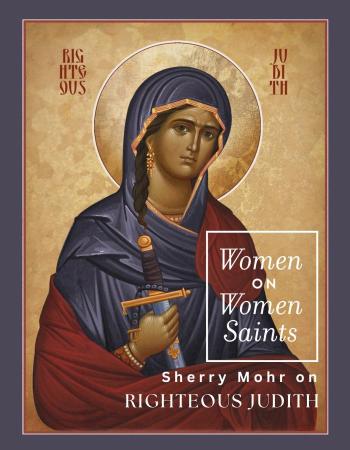
A lesser-known testimony of boldness and salvation, the Book of Judith was written during the Maccabean revolt by an unknown author. It is considered an apocryphal text, included in the Septuagint and in other biblical translations that contain the deuterocanonical texts. The Book of Judith has become one of my favorites because she serves as an example of a woman who did not let her position in life dictate her service to God. Judith is a story of trusting in God wholeheartedly, of courage to go against the grain, and of magnanimous beauty against the onset of violence and fear.
In the account, Nebuchadnezzar sent his commander, Holofernes, to lead a campaign to expand his empire. After learning about the strength of the Israelites, Holofernes became obsessed with the idea of conquering them and destroying their God. Although the Israelites in Bethuliah did not initially fear Nebuchadnezzar’s wrath, desperation and fear finally sank into their hearts after he cut off their water supply. They urged their leaders to surrender.
Uzziah, the chief priest of Bethuliah, advised them to fast and pray for five days, appealing to God for help and salvation. Surely, God would not abandon them. But if God did not respond to their appeal after these five days, Uzziah would submit to Holofernes.
Judith enters the stage at this moment. Judith is a feminine given name derived from the Hebrew Yəhūdīt (יְהוּדִית), meaning "praised" and, more literally, "Woman of Judea". She was a young, wealthy widow who inherited her husband’s wealth and household after he died during the barley harvest (most likely from heat stroke). At this point in the story, Judith had been a widow for 3.5 years. The scripture does not mention any children in her household. She was well-respected in her community for her holiness and God-fearing nature. She was in a constant state of fasting and prayer. Instead of enjoying her wealth, she confined herself to her room and wore haircloth, uncomfortable clothing made out of thick animal hair, living in consecration to the Lord.
She was also known for her stunning beauty. Despite her chosen attire, she commanded presence. As they succumb to fear and panic, Judith admonishes the elders and the people for testing God and proceeds with a dangerous and life-threatening plan to save her people. Judith would “defect” from the Israelites and present herself to Holofernes under the false premise of assisting in his plan to conquer them. Using her beauty, intellect, and charisma as battle weapons, she would win his trust and strike him dead when he least expected it.
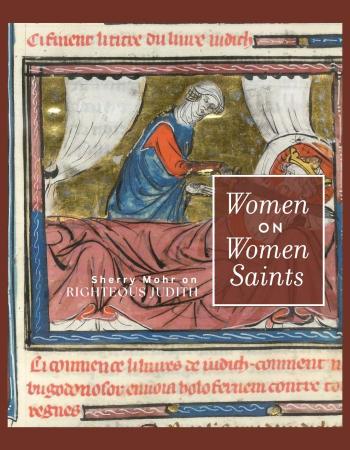
What I admire most about Judith is not only her deeply rooted relationship with God, but her willingness to trust Him in the darkness. The plan she pursued could have resulted in her death, and, in this way, Judith seems to be an archetype of the Theotokos. What amazes me even more is that the priests and elders were willing to let her sacrifice her life for them. Maybe her boldness frightened them. Maybe they saw God shining brightly through her. Perhaps God's Spirit overcame them, but the stark contrast between Judith and her people stands out sharply in this scenario, and I can't help but wonder: who do I want to be in this life? Christ calls us to pick up our cross and follow him. Though written before the birth of Christ, Judith appears to follow this command, and may also possibly serve an archetype for Christ, who laid down his life for His friends, so that they may live.
I admit that when I first read this book, my heart filled with frustration and confusion. How could this woman move so seamlessly and with such confidence? How did she know what to do and how to do it? Judith's complete trust in God allows her to speak with authority, His authority, and He gives her the words to say. From Judith, I learn that courage does not mean the absence of fear. She prayed every second of her mission and did not depart from God at any point. Even as she adorned herself to enter into Holofernes’ world, she recited prayers, appealing to God for guidance, wisdom, and discernment. She boldly asked Him for what she needed. As a result, the Lord enhanced her strengths, increasing them beyond measure.
Judith did not move without God. She recognized who she was in light of God’s glory. She understood that it was through God and God alone that she was able to conquer Holofernes.
She saw His might and wielded it like a sword – Holofernes’ sword, in fact.
Judith’s story reminds me that we can be women of God, prosperous and faithful, without having to compromise who we are. Judith knew to whom she belonged. Her deeply rooted relationship with God firmly grounded her in Him. When trouble and tribulation came into her life, she knew to rely on God and turned to Him first. She could discern His voice in her heart.
Judith’s boldness and trust in God to guide her illustrates to me that it truly doesn't matter who I am or my place in society; God works all things together for the good of those who love Him, who are called according to His purpose (Romans 8:28).
The Canticle of Judith
Then Judith began this thanksgiving before all Israel, and all the people loudly sang this song of praise. 2 And Judith said,
Begin a song to my God with tambourines,
sing to my Lord with cymbals.
Raise to him a new psalm;[a]
exalt him, and call upon his name.
3 For God is the Lord who crushes wars;
for he has delivered me out of the hands of my pursuers,
and brought me into his camp, in the midst of the people.
4 The Assyrian came down from the mountains of the north;
he came with myriads of his warriors;
their multitude blocked up the valleys,
their cavalry covered the hills.
5 He boasted that he would burn up my territory,
and kill my young men with the sword,
and dash my infants to the ground
and seize my children as prey,
and take my virgins as booty.
6 But the Lord Almighty has foiled them
by the hand of a woman.
7 For their mighty one did not fall by the hands of the young men,
nor did the sons of the Titans smite him,
nor did tall giants set upon him;
but Judith the daughter of Merar′i undid him
with the beauty of her countenance.
8 For she took off her widow’s mourning
to exalt the oppressed in Israel.
She anointed her face with ointment
and fastened her hair with a tiara
and put on a linen gown to deceive him.
9 Her sandal ravished his eyes,
her beauty captivated his mind,
and the sword severed his neck.
10 The Persians trembled at her boldness,
the Medes were daunted at her daring.
11 Then my oppressed people shouted for joy;
my weak people shouted[b] and the enemy[c] trembled;
they lifted up their voices, and the enemy[d] were turned back.
12 The sons of maidservants have pierced them through;
they were wounded like the children of fugitives,
they perished before the army of my Lord.
13 I will sing to my God a new song:
O Lord, thou are great and glorious,
wonderful in strength, invincible.
14 Let all thy creatures serve thee,
for thou didst speak, and they were made.
Thou didst send forth thy Spirit,[e] and it formed them;
there is none that can resist thy voice.
15 For the mountains shall be shaken to their foundations with the waters;
at thy presence the rocks shall melt like wax,
but to those who fear thee
thou wilt continue to show mercy.
16 For every sacrifice as a fragrant offering is a small thing,
and all fat for burnt offerings to thee is a very little thing,
but he who fears the Lord shall be great for ever.
17 Woe to the nations that rise up against my people!
The Lord Almighty will take vengeance on them in the day of judgment;
fire and worms he will give to their flesh;
they shall weep in pain for ever.
Chapter 16, vv.1 - 18