Christina Veselak, Woman of the Week
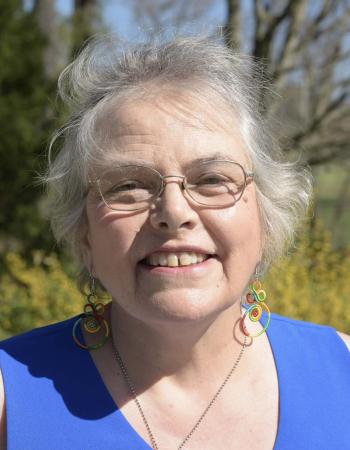
Our Woman of the Week is Christina Veselak, nominated for her work in addiction recovery ministry. We asked her to tell you how she found her calling:
“When I was a teenager, my father died very suddenly while we were living in Spain. My family had been planning a three-year sailing trip around the world, but after his death, all of that ended. Instead, I found myself at a boarding school in England—one that was advertised as a top-tier, elite tutorial college for serious students.
“The reality was very different. It turned out to be a dumping ground for troubled kids—teenagers with serious behavioral problems whose desperate parents didn’t know what else to do. Out of a hundred students, maybe five of us were there to study. The rest were there to party.
“I was the “good kid” who wanted to learn, but I was also traumatized and lonely. My first roommate was the daughter of a well-known British novelist. She was addicted to everything imaginable. After a couple of weeks, she told me she admired me and wanted to clean up her life, get good grades, and stop using drugs. In all my youthful naivete and love, I poured myself into helping her. For a while, things went beautifully. Then her beloved aunt died, and I came back from a weekend away to find a note on my bed: I’ve gone to be with real friends.
“The next time I saw her, she looked like a wraith. It broke my heart. She died at age 30 of unknown causes.
“Other roommates followed—some into hash and marijuana, some telling me their drug stories and asking me to play lookout for the landlady. Life rolled on, and I didn’t tell my mother what was happening. She was grieving too, and I thought she didn’t need more on her plate.
“Then one night, a sixteen-year-old boy jumped out of a third-story window during an acid party at the school. He died.
“The headmaster gathered us all and said: Don’t go to the police. Don’t tell the press. Don’t even tell your parents. Nothing happened. He blackmailed witnesses into lying under oath and covered everything up. Later, my friends and I discovered how the students—many of whom never studied—still managed to get into top universities: the headmaster himself was the exam proctor. For the right price, he “corrected” their answers.
“Once we figured this out, three of us went to the police. We were young and scared, but we couldn’t keep silent. At first, the officer assigned to us seemed to take it seriously—he even told me that the headmaster was a suspect in a local smuggling ring and asked me to participate in a sting operation. At the last minute, I refused. The next morning, I was told that the officer had suddenly been transferred across the country, never to return. The case was closed.
“Soon after, we saw the headmaster chatting casually with the chief of police.
“That was the moment I realized I had come face-to-face with sheer, unadulterated evil. At sixteen, I didn’t have the resources to confront it, but I knew my own strength wasn’t enough. My love for my friends wasn’t enough. My passion for justice wasn’t enough. I needed God.
“When my mother finally decided to return to Santa Barbara, I began searching in earnest. I prayed every night, asking to know who God really was. At seventeen, I became a Christian.
“I started out with a Pentecostal prayer group at my high school, then went on to a Baptist college where I studied philosophy and religious studies. I even became president of the Homiletic Society—the only woman in a group of men training to preach. I loved it. I loved giving sermons, leading worship, and serving as a kind of pastor.
“Eventually, I co-pastored a house church for two years. God’s grace was with us, but we knew we weren’t meeting the congregation’s real spiritual needs. When the church disbanded, it broke my heart. It was the only community where I had felt truly at home in ministry. Around the same time, I was earning my master’s in counseling.
“That was when I was introduced to Orthodoxy. My boyfriend—who later became my husband—was Catholic and attended a Melkite parish. I started going with him, and a few years later, I was chrismated Orthodox.
“Meanwhile, God had other plans for my career. After all the trauma I had seen in school, the last thing I wanted was to work with addiction. I avoided it at all costs. But when I finished graduate school and desperately needed a job, the only position available was at a residential treatment program for court-ordered teenage boys with alcoholism and conduct disorders.
“I resisted for months, but eventually, hunger won out. I took the job. I told them, “I don’t know anything about addiction,” and they replied, “We’ll teach you.”
“And so, after years of running from it, God led me right back to the world of troubled, addicted teenagers—the very world I had witnessed in England. Only this time, I had the tools, the training, and the faith to do something about it.
“That’s how God pulled me into the field of addiction treatment and recovery.”
“I’ve spent forty years as a licensed psychotherapist working in the addiction field in a variety of roles. About ten years into my career, I discovered that nutrition matters profoundly to people’s recovery journeys. That’s when I was introduced to amino acids—the building blocks of the mood-mediating chemicals in the brain. Addiction depletes these neurotransmitters, and when they’re depleted, people experience cravings and relapse.
“There are four primary neurotransmitters involved. The pharmaceutical industry has spent decades trying to develop drugs to support them, but here’s what I found: when people stop using, their brains are starving. They haven’t been eating well, and their neurotransmitters are profoundly depleted. This drives the misery of withdrawal, the intensity of cravings, and the high rate of relapse. Many end up switching their addiction to sugar, which also fires these neurotransmitters and acts like an addictive drug.
“Through study and experience, I became a certified nutritionist specializing in mental health nutrition, one of the very few applying functional nutrition to addiction recovery in this country. What I’ve seen is clear: if people in early recovery eat 20 grams of protein every four hours, take amino acids, and get real food into their bodies, their cravings decrease significantly. Relapse rates go down. And they no longer need to swap drugs for sugar, because their brains are finally getting the nutrients they need. This also helps tremendously for people with many different mental health concerns.
“This isn’t new science. The research goes back to the 1960s. Bill W., one of the founders of AA, actually used nutritional therapy himself and found it profoundly useful. He even did research within AA, though few people know this. Unfortunately, medical schools and pharmaceutical companies control most of the education, so nobody is being taught about it.
“For the past thirty years, I’ve been showing up at addiction conferences teaching this message. I tell people: you don’t have to believe me. Just try it for a week and see what happens. Over and over, I’ve watched lives turn around.
“In 2015, I was so impressed by the results I was seeing—especially with clients who had been “treatment failures” elsewhere, the very people my colleagues referred to me—that I started the Academy for Addiction and Mental Health Nutrition to teach other practitioners how to use these tools. I had learned by then that something as simple as missing a meal was one of the most common triggers for relapse, and that protein every four hours was one of the most effective preventions.
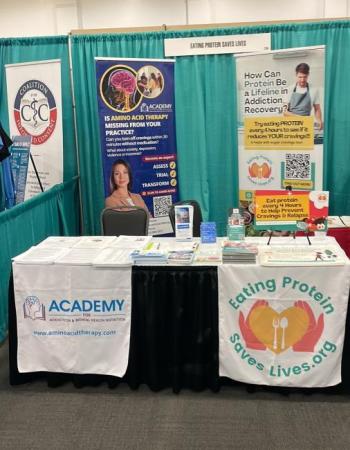
“In 2021, I also founded a nonprofit, Eating Protein Saves Lives. I’ll admit, I don’t know how to run a nonprofit or how to fundraise. We operate by the seat of our pants. But the purpose is clear: to educate ordinary people, because this message saves lives. I wish I had billboards across the country proclaiming it. What I can do, though, is write a book.
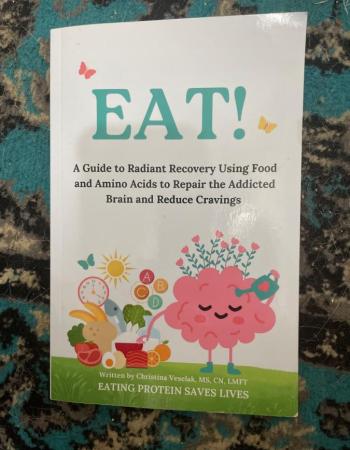
“For years I resisted the idea. I thought everything had already been written. But eventually I realized this book hadn’t been written. So I wrote EAT: A Guide to Radiant Recovery Using Food and Amino Acids to Repair the Addicted Brain. It’s designed to be accessible—about an eighth-grade level, with graphics and bite-sized sections—so that anyone can read and use it. It’s self-published, so there’s no publishing house behind me, but it’s selling. At a recent conference, I brought thirty copies, and they all sold. Slowly but surely, it’s getting out there.
“On a personal level, I know this is what the Lord has been calling me to do: to bring this message into the world because it matters. But that means I have to bring myself into the world, too. And that’s been hard. I used to be profoundly shy. Even after I’d mostly outgrown that, the thought of really putting myself out there still felt impossible. But God kept saying, yes, yes, yes.
“To respond, I’ve had to engage deeply in my own healing journey, particularly in trauma recovery, because I carry a lot of trauma. Doing this work has required a focused, persistent commitment to healing, even when it’s hard. It’s also required a profound shift in my relationship with God, because this isn’t something I can do on my own.
“I’ve been teaching for years, so speaking at schools or conferences doesn’t faze me anymore. But stepping into visibility in other ways—making short videos, knocking on doors, showing up and saying, “I have an important message and you need to listen to me”—that’s been new and daunting. Step by step, I’ve learned to do it, while also taking care of the younger parts of myself, reassuring them that the world is actually safe.
“That’s the work: healing, showing up, and proclaiming the message that nutrition saves lives.”
As always, we asked our Woman of the Week, Christina Veselak, about her morning routine:
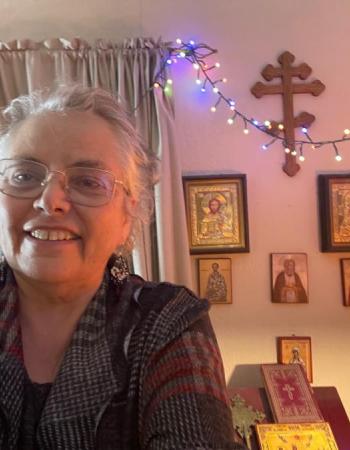
“When I wake up in the morning, I usually lie in bed and say the Trisagion prayers, followed by some intercessory prayers. Then I get up, make a cup of coffee, and settle into my big, comfy chair. From there, the morning can take a number of different directions. Sometimes I go deeper into prayer—saying the morning prayers, praying an akathist—or I might simply talk to God while working on a crossword puzzle. The crossword helps my ADD brain focus, so that I can actually enter into my heart and listen.
“About half the time, I start my day that way. The other half, I sit down with my coffee, open my phone, and the day takes off running.
“My prayer life is very much tied to what I’m going through. If I’m struggling, prayer deepens. And I’ve had a lot to struggle with. Two and a half years ago, I was re-diagnosed with cancer. At that point, 85% of my bone marrow was cancerous. I spent six months in bed, and since then, I’ve spent the last two and a half years slowly getting out of bed again.
“Mostly, I’m doing well now. I can work a full day, I can travel, I can teach, I can write, I can create. But I also live with end-stage arthritis in my knees, which means I can’t walk more than a block. Earlier this year, I was in a wheelchair for two months—right in the middle of organizing a big conference. The conference was successful, though it left me with some debt because I didn’t get the financial backing I had hoped for. That’s been a pattern in my life: chronic illness, financial challenges, and the constant call to simply push through.
“But being confined to bed changed me. For decades, I had been a workaholic, driven to prove myself—maybe even to those third-grade bullies from my childhood. Lying in bed for six months forced me to stop. With the help of my therapist, I realized I couldn’t keep living that way. I had to learn to do life differently.
“That hasn’t been easy. I’ve told the Lord, “I don’t know how. I’m almost 70—you’re going to have to show me.” And He has. I’m still learning. I no longer push through fatigue or pain the way I once did. If I need to stop, I stop. That’s what keeps me going now.
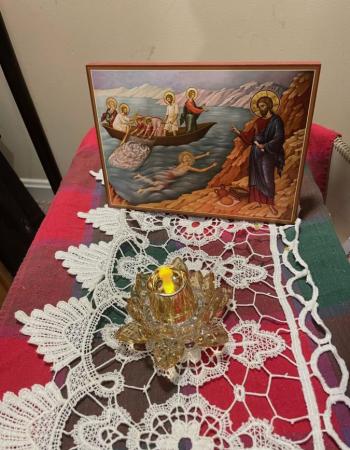
"Ironically, at the age when most women are retiring, I’ve started an entirely new career. What began as a hobby in 2015—teaching other practitioners how to use nutrition to support addiction recovery—has become a school, a nonprofit, a book, and a whole new mission. When illness made it clear that I couldn’t keep up my old pace in Denver, my husband and I moved to Wayne, West Virginia. At the time, he was a priest in ROCOR, and Wayne had the only ROCOR parish in the state. That situation eventually proved untenable, and now he’s back in the OCA, though the nearest parish is two and a half hours away. In the meantime, we’ve been worshiping with the Antiochians, and we’ve also formed a close connection with Holy Cross Monastery nearby.
“Moving here felt like jumping off a cliff. I knew we had to come, but I didn’t know why or what we were supposed to do. It has been profoundly transformational. I’ve stepped into being a business owner, taken marketing and entrepreneurial classes, and embraced the work required to get this message out into the world.
“That’s how my book came to be. It’s the fruit of this whole journey, the endpoint of six years of upheaval and renewal. When we moved here, I thought I was going to semi-retire. Instead, I find myself running a school, growing a nonprofit, writing, speaking, and putting on conferences. And I just turned 69.
“Looking back, it all makes sense. I can’t separate my spiritual life from any of it. The work, the struggles, the healing—all of it is tied together. At its core, my message is simple: eating protein saves lives. That’s the name of my nonprofit, and that’s the truth I want to shout from the rooftops.
“I hope people will connect with me, especially if this resonates. I certainly need help with the nonprofit, because I’m figuring it out as I go. But we’re still here, still actually saving lives, and that counts for everything.”
Thank you, Christina!