St. Febronia
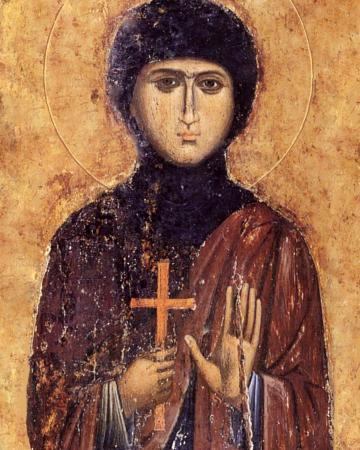
“Accept me as a pure sacrifice, for I have offered myself in love.” - from a Troparion for St. Febronia
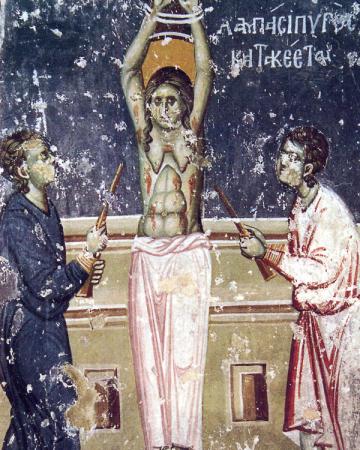
St. Febronia is often known for the excessive tortures which she endured in her martyrdom - so excessive, in fact, that when her aunt and Abbess saw her disfigured body, she “fell senseless” in agony.
Today, however, we’d like to meditate on who she was as a person. At a time when many Christians lived under a growing fear of persecution, how did she become a woman of such peace and courage? What daily choices, perspectives, and habits formed her life?
Tradition tells us that St. Febronia was orphaned at a young age and raised in a women’s monastery in Sivapolis of Assyria, where her aunt, Bryaίnē, was Abbess. Her aunt held St. Febronia to a high standard compared to the other sisters, but she also gave her a great gift: she taught her to read. When holy books were read during mealtimes in the monastery, St. Febronia was usually the one to do so.
At some point in her early life, St. Febronia had to make a choice: would she continue simply following the motions of her aunt’s faith, or would she give her whole self to it, heart, mind, body, and soul? Whether or not this was a struggle, we don’t know. What we do know is that St. Febronia chose the way of love. She gave herself to ascetic struggles but also to the care of those around her. Women in the city began to come and visit her, some who eventually accepted Holy Baptism. Prayers she had prayed at first with such struggle, and the words she read aloud to her sisters each week, slowly began to take deep root in her heart.
When she was around twenty years old, St. Febronia fell seriously ill. So ill, in fact, that when news came that the envoys of the Emperor were coming to persecute Christians, she could not flee with the rest of her sisters. Her aunt stayed behind to care for her along with another assistant, who later wrote the account of St. Febronia’s life. As they sat together by her sickbed, did they speak together of the rumors flying about like swallows in the city? Did they urge each other towards the strength and faith that could outstrip death?
What we do know is that St. Febronia was offered a chance to be spared, if only she would deny Christ. Weakened by illness and from seeing her aunt humiliated, we can guess that St. Febronia felt all the confusion and terror of what was before her. Her prayer has been recorded for us: “My Savior,” she cried, “do not abandon me in this terrible hour!”
Yet St. Febronia stood firm. The Coptic Synaxarion tells us that early on, her torturers cut out her tongue so that she could not pray - a witness to the way she clung to her faith in the midst of great pain. The words that had risen to her lips over and over in the daily struggle of prayer now came as a lifeline to keep her from drowning. After her martyrdom, St. Febronia’s body was brought home to the monastery and many came to venerate her relics as a witness of what a human could withstand and overcome out of love.
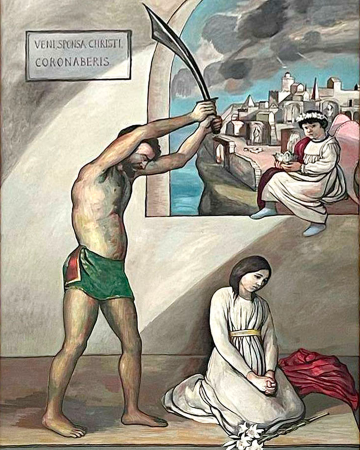
Soon after St. Febronia’s death, Saint James the Bishop of Nisibis built a church and transferred into it a portion of her holy relics. Some traditions tell us that after her death, the envoys Lysimachus and Primus, who were responsible for such terrible tortures, renounced their idol worship and accepted both baptism and monasticism. Perhaps witnessing such suffering finally broke down their defenses, and inspired awe in the courage of a young woman who could withstand it with such faith.
A wealthy widow who had been converted by St. Febronia, named Hieria, gave her wealth to the convent and petitioned Abbess Bryaίnē to accept her at the convent in place of St. Febronia. In all of these ways, the powerful witness of her life continued to live on.
Every year, on the day of St. Febronia’s martyrdom, a solemn feast was celebrated at the monastery, and it was said that St. Febronia could be seen at her usual place in church. She accompanies us still today in all of our moments of fear and danger, a reminder that death is no longer our enemy, and that in Christ we are capable of much more than we know.
Holy Mother Febronia, pray to God for us!