Meet Natalie Kapeluck, Woman of the Week!
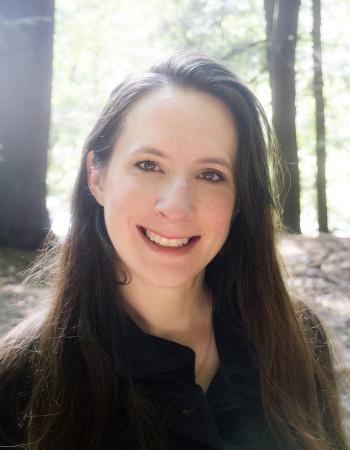
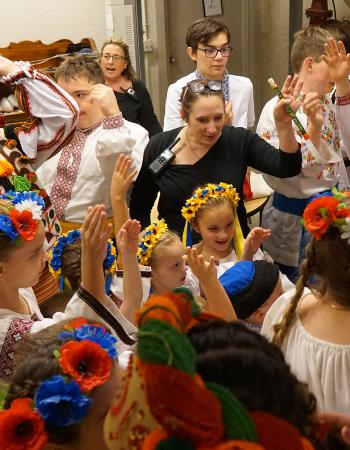
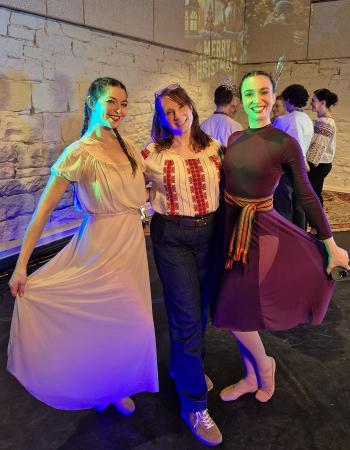
Our Woman of the Week is Natalie Kapeluck, who is Director of Youth and Young Adult Ministries of the Ukrainian Orthodox Church of the USA. She was nominated for her extraordinary national role in serving youth and young adults and disabled parishioners in her church and serves alongside her counterparts across jurisdictions through the Assembly’s Orthodox Youth Directors of North America, which meets regularly to share resources and support one another. You see her below with dancers from her company Slava Dance during a recent performance, and backstage before a show with the Kyiv Ukrainian Dance Ensemble. We asked her to share with you how she got from where she started to her current long-serving role:
“I actually had a whole separate career before this. I never imagined I would work for the Church. I trained as a dancer and danced professionally for a little over ten years. I was a modern dancer, though I started in ballet. In college I realized I could never really “drop the weight” the way ballet required. I was tiny, and still couldn’t quite do it. But when I was introduced to modern dance, it opened a whole new world for me. That became my early career, and it’s still a big part of my life.
“I started working with dancers with disabilities because I had a very forward-thinking director in our company, Mary Miller. She trained in New York as a dancer but also pursued additional certifications, including work in psycholocomotor therapies. She always believed dance wasn’t only about performance or running a company—it was about bringing movement to people. In Pittsburgh, she looked for outreach opportunities and established a residency at the Western Pennsylvania School for the Deaf. She truly believed everyone should have the opportunity to dance.
“I learned so much from her about teaching people how to move and making dance accessible. She later began another program at a school for the blind, where I taught for five years. After I retired from performing, she invited me to teach through a program called Move for Life, which focused on seniors. We worked in rehabilitation and senior facilities with anyone who wanted to participate, especially those in wheelchairs or with limited mobility. I’m deeply grateful to my former director. She taught me an enormous amount about working with people with disabilities, and that experience shaped my approach in lasting ways. I really feel that God has placed some extraordinary people in my life.Oddly enough, it also played a role in my journey to becoming a youth director.
“I never fully left dance. Even after taking this youth ministry position, I kept teaching. At one point I had two dance companies; now I have one. God gave me that gift, and it still plays a large role in my life. Looking back, I was always one of those kids who was deeply involved in the Church. My parents raised my brother and me to serve, so stepping up and helping was simply what our family did. Around age 16, I began helping in church school while I was still a student myself, working with the younger children. At the same time, I was a junior camp counselor. I also started teaching ballet and Ukrainian folk dance around age 15. In college I taught dance constantly to earn money, and I stayed involved in camping ministry. After graduating, I returned to my home parish, looked around and thought: we have a wonderful church school, we have the dance group—but we had nothing for college students. This was around 1995.
“I went to a parish meeting—somehow I had the nerve—and said, “Can we start a youth ministry here?” They asked what that meant, so I put together a proposal. By the grace of God, my parish, which is truly wonderful, said yes to this 23-year-old kid who didn’t really know what she was doing. That’s how I started a youth ministry program in my parish, all while I was still dancing professionally. My life was running on two tracks at once.
“I really believe that God leads us and plants things along the way for where He wants us to go. During my years dancing professionally, my company had teaching residencies at the Western Pennsylvania School for the Deaf, and I taught there regularly for eight years. I also have a son with Down syndrome, so these threads kept building in my life. I stayed involved in camping ministry and gradually moved from cabin staff into administrative roles. God gave me many opportunities to learn youth work from the ground up, simply by doing the work. I was also blessed with wonderful mentors, including Gayle Woloschak, as well as the strong example of my parents and my older brother, whose faith I always admired. After the Ukrainian Orthodox Church began formalizing its youth ministry, a couple of directors didn’t work out, and I received a rather unexpected call from my Metropolitan. He told me that he and the Archbishop had a position they wanted me to take: Director of Youth and Young Adult Ministries. At the time I was still dancing professionally, and this was not on my radar at all. I was shocked. I actually told him no. I didn’t have a seminary degree, and although I was already involved in youth and young adult work through the Ukrainian Orthodox League, this felt like something entirely different.
“That summer at camp, though, a few things happened that I truly believe were moments of intervention—through the Theotokos, honestly. He asked me again, and eventually I said yes. I probably shouldn’t have, but I did. This year I celebrated my twenty-fifth anniversary in the role, and it has been quite a journey.
“Along the way, disability ministry also became central to my work. Early in my career we adopted three orphanages in Ukraine that served youth with disabilities. Later, when I became the parent of a child with disabilities, that deepened my perspective even more. I began to see a growing need in both youth and camping ministry to better support our faithful with disabilities. So I added a component to our department called the St. Nicholas Ministry, which provides resources to families and parishes and walks alongside children with disabilities. We also run four-day family camp programs under that umbrella.When I look back, I can see how all these small things God placed in my path—dance, teaching, camp, parish service, disability work—formed me for this vocation. Even teaching dance helped me learn how to work with parents and with children of different ages. That’s really my story. I’ve been here for twenty-five years now.
“I’m based in Pittsburgh, and I can’t say enough about my bishops for hiring me without a seminary degree and, frankly, as a woman, in the year 2000. If you looked at the landscape of Orthodox jurisdictions then, it was almost entirely clergy and almost entirely men. I would walk into pan-Orthodox meetings and often be the only woman in the room.They also allowed me to work remotely, which was quite unusual at the time. Our Metropolitan lived in Pittsburgh rather than at the Archdiocesan Center, and my office was across the street from his home. He would walk over occasionally—he wasn’t very tech-savvy and still used a fax machine—and I ended up helping him quite a bit in those early years. I was never formally his secretary, but I was the only employee in the city, so I naturally took on some of that support. He would sometimes call and ask for help with speeches or other tasks, and that mentorship was an incredible blessing at the beginning of my ministry.
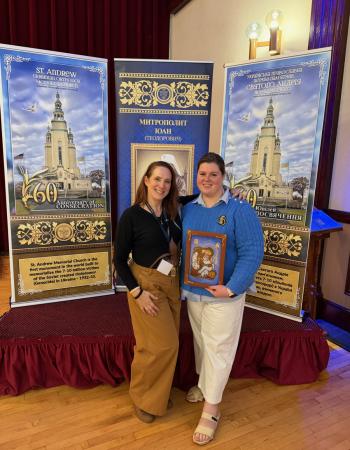
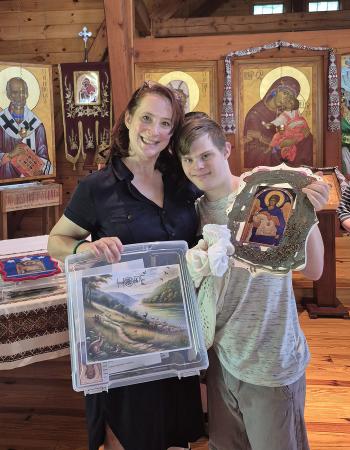
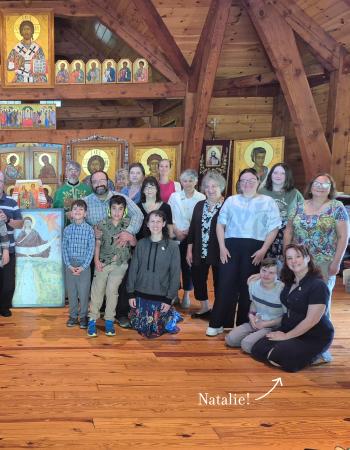
Here you see Natalie presenting intern Olena Lymar with an icon during the Ukrainian Orthodox Church of USA Sobor (clergy/laity), as well as a group photo St. Nicholas Family Camp for families with disabilities. We asked her to tell you what she would change about the Church’s approach to youth ministry, if she could:
“I wish we could move more fully toward recognizing—both in our parishes and in the broader Orthodox world—that caring for our youth is the responsibility of all of us. It isn’t only the task of a church school administrator, a youth director, or a department of youth ministry. Those roles exist so that the work can be developmentally appropriate, but ultimately the responsibility belongs to the whole Church.
“It is all of our responsibility to form our young people in Christ. And beyond that, I wish we truly saw our children and young people as full members of the Body of Christ from the moment they are baptized and chrismated—not only once they turn eighteen and can contribute as adults. A nine-month-old, a nine-year-old, and a sixteen-year-old all have the same place within the Church and within God’s love as any adult.
“This also applies equally to youth with disabilities. In that sense, there is no difference—they are simply part of the Body. As we care for the Body, we care for its different members in different ways. We care for the elderly differently, the young differently, and those with disabilities somewhat differently, but we are all part of the same Body and should care for one another as needed. Sometimes people are hesitant because they don’t know what to do or what to say. That uncertainty can lead to a kind of paralysis where nothing happens at all. Realizing that it is all of our responsibility to care for one another—spiritually and physically—is essential.
“One of the most meaningful parts of my work has been serving alongside my counterparts across jurisdictions through the Assembly’s Orthodox Youth Directors of North America. Those of us in similar roles meet regularly to share resources and support one another. Much of that work happens behind the scenes, so people don’t always realize how much cooperation already exists. But it has helped create a more common language in Orthodox youth formation today. Some of the terms and approaches people use now actually grew out of that collaborative effort, which was originally encouraged by the Assembly of Bishops. I think there is more cooperation within the Orthodox Church than people assume—we simply don’t talk about it very much.”
As always, we asked our Woman of the Week, Natalie Kapeluck, to tell you about her morning routine:
“I groan. I check all the aches and pains. Then I get my son ready for school. He’s technically a senior, but because of the type of school he attends, he’ll have extended schooling until he’s twenty-one. So he’s a senior—but also not, if that makes sense. Policies around disability and education vary by state, and in Pennsylvania things have shifted recently, so it’s a bit of an in-between category. Like most teenagers, he wants to sleep until the last possible minute, so lately we’re up around seven to get him out the door. He takes the bus. He attends a school in Pittsburgh for young people with disabilities. That’s really the main anchor of my morning.
“After that, every day is a little different. Sometimes I crawl back into bed for a bit; sometimes I start moving right away. I make coffee—my own little concoction—take my vitamins, and usually try to go to the gym. I also try, as best I can, to say my morning prayers. At this age things move a little more slowly, and I’m just happy to get up and get going. One thing I do consistently is call a close friend and ask, “Are you up? Are you out of the house yet?”
“I still do a lot of stretching every day as a dancer. When I go to the gym, I usually find a little corner and do my own dance-based training. My body responds better to that. I know other former dancers do more conventional workouts, but I really have to stick with what works for me. The gym doesn’t have a barre, but I’ve improvised. There are railings and open floor areas, and I use the mats. As a modern dancer, I spent a lot of time working on the floor anyway—lying, sitting, moving through grounded exercises—so that translates well. Then I’ll do a bit of barre work wherever I can.
“So really, my morning routine is: get my son off to school, try to pray, and go to the gym.”
Thank you, Natalie!