Meet Beth Rustigian Broussalian, Woman of the Week
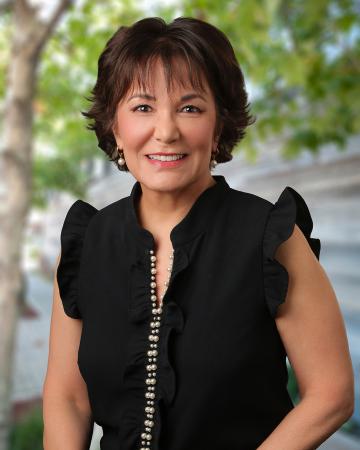
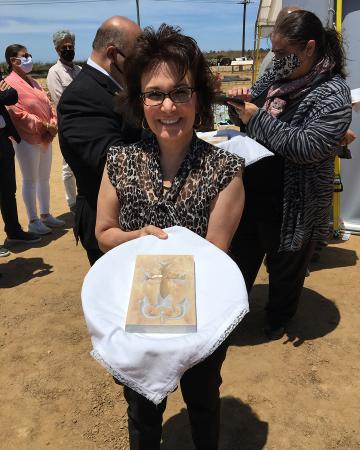
Our Woman of the Week is Beth Rustigian Broussalian, who helped found, organize, and build the Armenian church of St. Sarkis in San Diego, California. We asked her to tell you how she came to do that. You see her here with one of the cross-etched stones that were planted at sixteen points in the foundation when ground was broken for the church:
“I have to go way back in history. My father’s father was one of the founding godfathers of the first Armenian church in California, in Fresno in the early 1900s. My mother’s parents were benefactors of our church in Oakland in the 1950s. Being involved in the church — and even church construction — is just part of my DNA.
“Most Armenians came to the US after the massacres of 1895–1896 or after the genocide in 1915. My father’s parents settled in Fresno in the early 1900s. They were deeply traumatized, especially my grandmothers.
“Recently, during the April 24 commemoration of the Armenian genocide, the archbishop in New York wrote something that really stayed with me: ‘Our faith is deeper than our suffering.’ People often ask how Armenians held onto their faith through unimaginable tragedy, and he said, ‘Wherever we ended up is where we planted our faith.’
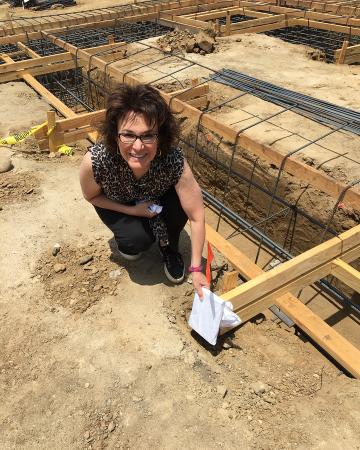
“I grew up in the Oakland church. Sunday School every week, constant church activities, surrounded by Armenian families. We had Armenian families in our high school in Lafayette, too, so between school and church, we saw each other six or seven times a week. It was a very tight-knit community. There are probably 20,000 Armenian families in the Bay Area. In San Diego, where I lived for 20 years, we had about 2,000 families in our church database, which made me think there were likely closer to 5,000 Armenian families countywide.
“Our church in San Diego was originally in North Park. The founders had only intended it to be there for five years, but we were there for 35. It was a converted synagogue that was falling apart, and it was far from where most Armenian families actually lived. At the same time, the biotech industry was expanding in North County, bringing more Armenian professionals into San Diego, so the church’s location and condition no longer served the community well.
“At the time, I was teaching Sunday school and Armenian school. Around 2008, there was a presentation about moving the church. Afterward I went up to the speaker and said, ‘I can help you with manpower and I can help you financially; I want to do both.” He later told me I was the only person who approached him after that meeting to offer help.
“There was already a trust committee handling long-term financial planning; about two years later I was invited to join. I was the only woman. The others were experts in finance, construction, and investments, while I came in as more of a community and marketing liaison. I built the email marketing platform, created the website, developed print materials, and helped launch the capital campaign that funded the project. That phase lasted about 7 years. The capital campaign was incredibly difficult in the beginning because all we had were architectural renderings. People had to believe in a dream. There was nothing tangible yet.
“Eventually I moved from the trust committee to the building committee because I couldn’t do everything at once. Again, I was the only woman for years, partly because I wanted to watch what was happening and make sure things were done in keeping with our original vision. Later I also joined the design committee, which was more evenly split between women and men. That part was especially fun, even though it was a tremendous amount of work.’
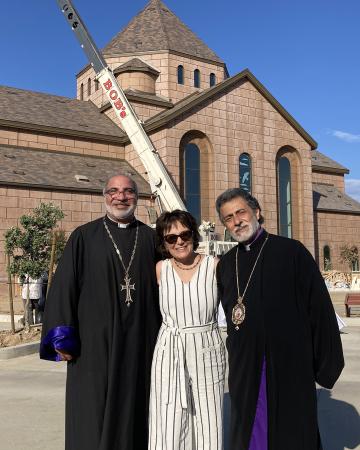
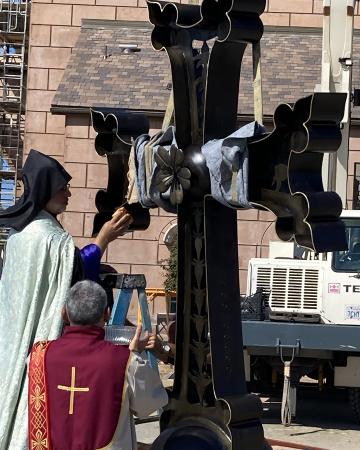
Beth Rustigian Broussalian is our Woman of the Week, nominated for her work helping found the church of St. Sarkis in San Diego, California. We asked her what she wanted you to know about some of what goes into physically creating a new church building. She shared the videos of putting the cross on the church dome and the “tilt-up” of one of the church walls (the builder poured the full concrete walls of the church flat on the ground, then used cranes to lift each entire wall into place–you need to see it to believe it!):.
“I was part of the team that interviewed architects for the project. We spoke with several firms and ultimately chose a local architect based in Cardiff. We wanted top industry professionals in San Diego, and that’s what we got.
“The exterior was mostly predetermined according to ancient Armenian church architecture, but the interior design was where we really shaped the vision. Traditional Armenian churches tend to be very dark, with deep maroon tones and heavy stained glass. We wanted the opposite: white walls, warm tones, blues reflecting the ocean, sandy colors reflecting the beach. Our mantra was, ‘Simple, simple, simple.’”
“We also made a very intentional decision: no fruit imagery. No grapes, no pomegranates, none of it. Those motifs are so common in Armenian churches that they instantly date the design. We wanted this church to feel fresh and timeless. That’s why the altar is painted blue and the entire sanctuary feels open and light-filled. Since the church opened, more decorative elements have been added than we originally envisioned, but the overall aesthetic still reflects what we wanted. Light was everything to us.
“We completely rethought the candle room. In most Armenian churches, candles are lit in the main sanctuary, but we created dedicated candle rooms as meditative spaces. I believe the concept originally came from the architect. We wanted people to have a contemplative place without disrupting the sanctuary during services, and it works beautifully.
“Another innovation was moving the bride’s room behind the altar. Usually it’s located closer to the entrance, but we simply didn’t have the space there. Most Armenian churches in the US have bride’s rooms, though not typically in that location.
“Once construction began, I handled all the naming donations. Opportunities ranged from the sanctuary itself — a $2 million donation — down to Bibles and prayer books. Every donor name had to be tracked, every plaque proofed, every inscription inserted. We were still placing donation inscriptions into Bibles right up until the consecration. It became a massive logistical operation. I had giant spreadsheets tracking everything. Every pew donation had to be labeled correctly before consecration. Every single element in the church was donated. We also had donors sponsor trees, benches, landscaping — everything.
“The sanctuary was only phase one. What we’re building is really a campus. Eventually there will be a social hall, a school building for Sunday school and youth programs, and a gymnasium with recreation spaces for young people.”
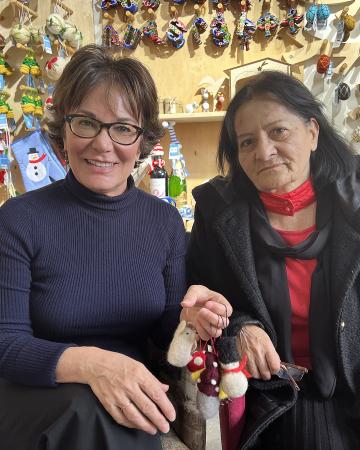
As always, we asked our Woman of the Week, Beth Rustigian Broussalian about her morning routine:
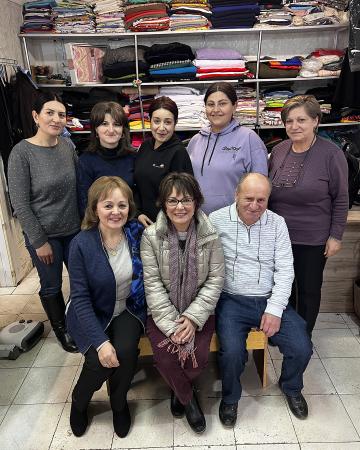
“I run a nonprofit organization, HDIF-USA, that imports fair trade handmade gifts from Armenia. We sell them here in the US, both within the Armenian community and through American retailers, as a way to create sustainable jobs for artisans in Armenia, especially women. Because of the time difference, I’m usually awake very late communicating with our team in Yerevan. So I don’t wake up until around 8:30 or 9:00.
“Once I’m up, I spend at least an hour reading social media and news to catch up on what happened overnight. It’s not necessarily a healthy way to start the day because it can be stressful, but that’s what I do.
“Then I make a protein shake, work out, do yoga, or weight training. I’m actually in much better shape now at 64 than I was in my forties.”
Thank you, Beth!