Locking Eyes with St. Olga: Bess Chakravarty and Her Miraculous Healing
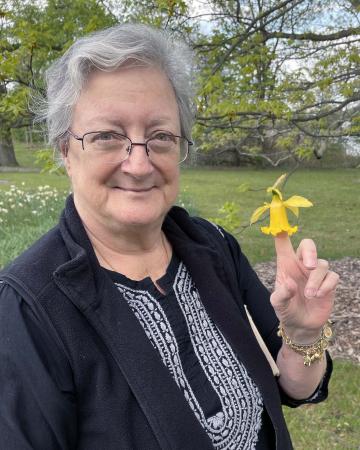
In 1997, an account of a women’s healing experience of Matushka Olga of Alaska was published within an article in Jacob’s Well. The anonymous woman who shared that story was Bess Chakravarty, who had been working at St. Vladimir’s Seminary Library and seeing Lyn Breck as a therapist during that time.
In the original article, Bess wrote: I know now that some very deep wounds were being healed at that time. She gave me back my own life which had been stolen, a life that is now defined by the beauty and love of God for me, the restored work of His Hands.
Now, after St. Olga’s glorification, Bess is ready to share more about her relationship with St. Olga, and how the healing she experienced during that time has continued to ripple into her life today.
As the original article inferred, Bess experienced terrible and prolonged abuse as a child, which left lasting effects of PTSD. “I’ve known in my head that God loves me, but until that healing prayer time with St. Olga I hadn’t known how to get through the trauma,” she explained. Although she was not yet Orthodox, she had visited an Orthodox liturgy at St. Vladimir’s. She was moved by the hymns to the Theotokos, especially when Lyn told her that one name for the Theotokos was “Quick to Hear.” Several days later, while resting in a darkened massage room at the chiropractor, she found herself calling out, “Theotokos help me!”
The Theotokos came to Bess immediately, and with her she brought St. Olga. And, Bess says, the scent of roses, lilies of the valley, and cedar stayed present throughout the whole appointment afterwards.
“There was a moment in that healing prayer when I locked eyes with St. Olga,” Bess explained. “All my life, I had lived with this sound of a disconsolate infant, constantly crying. When a mother looks into the eyes of her infant, all her tenderness pours out of her towards that infant, welcoming that infant to life. When St. Olga and I made that eyelock, time seemed infinite. And I never heard that infant cry within me again.”
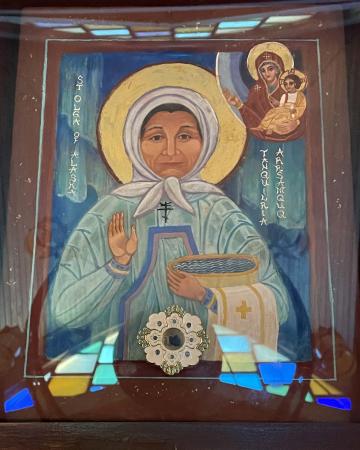
Bess told Lyn about the healing prayer, and the details she mentioned immediately made Lyn think of a woman she had heard about while teaching in Alaska, the mother of a student. This miraculous “coincidence” meant that Bess could write directly to St. Olga’s family about the experience, which she did. Each time a member of the family read her letter, they went through the same process: questioning, and then a sense of recognition. Re-reading the letter, each of them started to smell incense. Her eldest brother read it and took the letter to a younger sister, who had a blind lady visiting her. The woman asked him which church service she had missed, because she smelled the incense on his clothes. Specifically, it was the incense used at feasts of the Virgin - floral, with scents of lilies, roses, lilacs and cedar.
“So that’s how she told her children that she was a saint” – although Bess was quick to point out they already knew she had lived a holy life, and had experienced other miracles such as the thawing of winter during St. Olga’s funeral.
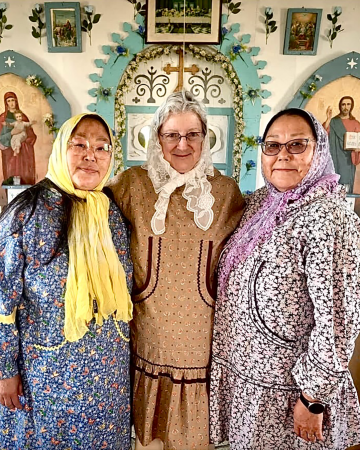
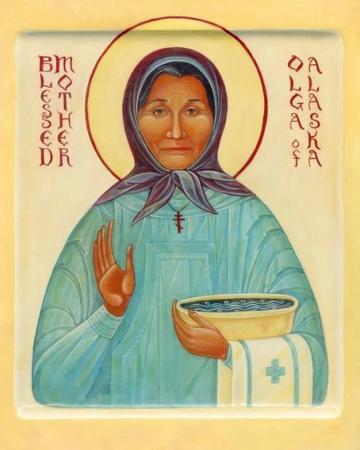
Since then, Bess has been up to Kwethluk to visit St. Olga’s family, and become good friends with her granddaughter, Wiz. She spent time from 1997-1998 at St. Herman’s Seminary, where Father Michael Oleksa and Matuska Xenia brought her to Kwethluk for Holy Week and Pascha. When she returned from her first trip to Alaska, she wanted to paint an icon of St. Olga since there had been none made yet, and received advice on its composition from Fr. Tom Hopko and Professor Richard Snyder at St. Vladimir’s Seminary.
A Profound Act of Forgiveness
The healing Bess experienced during her experience of St. Olga rippled out into the rest of her life. After chrismation, she realized that she had a lot of forgiving to do in order to continue the journey towards wholeness.
“My child abuse was severe and included sexual abuse and trafficking. It went for at least 10 years. I had talked about it enough for my spiritual father and priest, Father Paul Lazar of blessed memory, to know my story.
“Knowing I had a great many men to forgive, I needed to find a way to do that. So I asked my priest: if communion occurs in eternal time, may I take one man who had been one flesh with me to the Communion Cup, and ask Jesus, in his Body and Blood, to reveal Himself to that man?
“And Father Paul said, ‘Yes, I bless you to do that.’ I took communion like that for more than thirty years. The blessing from St. Olga was that I never remembered the traumatic event, the man, the pain, the panic, the terror. I was simply the intercessor, bringing this person to Christ. Whatever happened between Jesus and the man was up to them.
“It gave me a way to physically and fully forgive, although I was much more aware of carrying that man to Christ that it was about forgiveness. It was as if I was carrying a purified soul, not the sinful history, but the person God created, to Christ.
“And then there came a day when the walls of the church fell away. My soul was completely silent. I felt the peace of Christ without words, and I understood that the time for intercession was complete. After that, I started receiving simply for myself.
“During the next four years, as I prayed for the men in the evenings, I would often cry, because they had fallen so far short of who God created them to be. In the following three years, I began to feel a kind of tenderness. And by that seventh year of receiving for myself, I can actually tell you I loved them. I understood that when Jesus says ‘love your enemies,’ you have to unconditionally and completely forgive them, so there's nothing between you and them, and then God's love can pour through you to them. And that's the most beautiful part of all.
“I still have to work on some PTSD issues. Some healing is gradual. But there's one thing I am absolutely certain of: I would not give up one moment of suffering if it meant St. Olga would not have come. God needed a worst-case scenario so no one could say, ‘I'm too broken for St. Olga to help me.’
“Her glorification has changed one thing. Before that, I wanted to stay anonymous. I wanted it to be about her, not about me. Anonymity, I was sure, was necessary. Only a few priests, and most of the people of Kwethluk, knew it was my story.
“After her glorification, I feel very differently. If there is anyone who needs to talk about Mother Olga, or who I could help in prayer, or in conversation: my heart is bursting with Mother Olga’s love. And it feels like it should flow to the folks that need it, if I'm supposed to be that person, I am more than willing. I want to be able to be totally open to whatever the Holy Spirit has in front of me for however long I live.”
What Remains
Reflecting on St. Olga’s love and generosity, Bess said, “Love came first. Tradition, religiosity, second.” She saw that St. Olga gave to others in ways that minimized their shame. This approach to love profoundly influenced her.
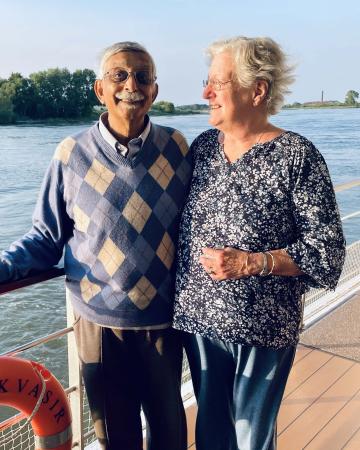
“I still see a therapist, a grief therapist,” Bess said. “My husband and I were married 54 years, but together 56 years. In the last years he had dementia. I can tell you I learned to love him in many different ways than I had done before.
“At the celebration of life we hosted after his death, many of the musicians came up to me and said, ‘I really wish we had gotten to know your husband. He seems like he was a marvelous man.’ And I said, ‘yeah, he really was.’
“You know Venn diagrams, where the circles overlap? As his caregiver at the end, we overlapped by so much that when he left, there wasn't much left of me. Now, I need to grow into who I'm supposed to be now. And I don't quite know who that is yet.
“Grief is like that. They say that for people who are full-time caregivers for long periods of time, it takes 3 to 5 years to begin making sense of your life after their death. But as we're talking, I'm realizing that it’s given me a special kind of quiet time, for my soul to catch up with how loved I am by God. I believe that empty space is the space that God wants to fill in my being.
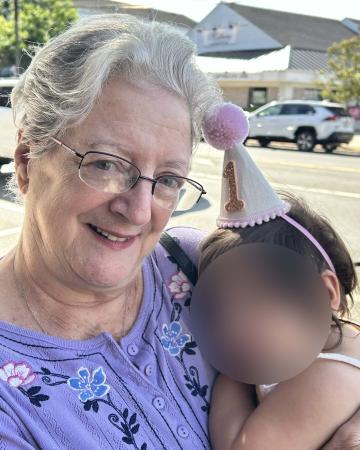
“There is not a soul born that isn't loved by God. Who we are in Christ is what remains. We were created to be loved by Him - and sparkle in the light of his love! It's amazing, it's unpredictable, it gives us so much more than we can even ask for or think about asking for. For me right now, it means to ‘comfort others with the comfort I have received,’ and for me that comes from Mother Olga.”
One-on-One with St. Olga
How did Bess know this was not a dream? It turns out she asked herself that very question. Bess shared with us that when she received the experience of St. Olga, she put it through three “tests” to determine whether it might simply have been a dream or delusion. Her three criteria were:
- It must accord with the Bible
- It has to remain fresh in her mind, like it just happened. All details must remain clear and unfaded because it takes place in eternal time.
- “It is as if your life is like a calm pond, and when you throw a small pebble into it, the ripples keep going and going until the last leaf on the shore is lifted,” she said. “It must permeate your being in a very real and holy way.”
Only when she determined that all three of these criteria were met did she share about the experience with Lyn Breck, in order to verify St. Olga’s identity. Looking back now after several decades, it is even more clear that these “ripples” did indeed keep lifting her as she continued to walk the courageous road of healing.
As mentioned before, Bess sometimes wondered why it was that St. Olga came specifically to her. She pondered Christ’s miracle of the wedding at Cana, or the appearance of the angels to the shepherds. “In the Scriptures,” she pondered, “it was always those who ‘didn’t count,’ the lowly, the forgotten, who Christ appears to. God is a come-as-you-are-God.” Even in her deep feelings of insignificance, she realized that this healing went beyond herself. It brought St. Olga forward for the first time. Bess learned that she could walk on the path to God's love for the wounded. She knew they were not damaged or rejected: they were His treasures who needed St. Olga's love, comfort and companionship. Because Bess had suffered deeply in many ways, she could listen empathetically and compassionately. That moves her to tears of gratitude.
“The most important thing that St. Olga said to me, when you condense the entire experience, was this: ‘Those men who you believe put their evil inside of you, that is a lie! The only thing that those men can put inside you was the seed of human life, which is from God and cannot be polluted.’”
Thank you, Bess!