Hilary Baboukis, Woman of the Week
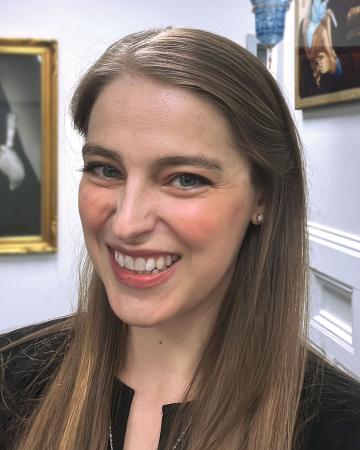
Hilary Baboukis is our Woman of the Week, nominated for her work as a professional singer and musician, a career which remains entwined with her Orthodox faith. We asked her to tell us how she got here from where she started:
“I grew up all over the place. My father was a university professor, so we moved around a lot, as sometimes happens in academia. I was born in Minnesota and then lived in Montreal, Georgia, and Illinois before going to New York for college; then Cairo, Oklahoma, and back to New York/New Jersey. I've been here ever since, and I'm hoping to stay.
“My dad was a professor of music. He was a composer and a conductor, he sang in choirs, and he was a psaltis in the Greek Orthodox tradition. My mom converted to Orthodoxy a couple years after they got married, so I grew up in the Orthodox Church, hanging around the chant stand and in the choir, harassing the nice choir ladies. That's how I became a musician: it's how I learned to read music, it's how I got comfortable with harmony, all of the skills I later needed.
“Because my dad was Greek and my mom was Orthodox but not Greek, we sort of split our time between the Greek church and the OCA. I grew up comfortable with both traditions.
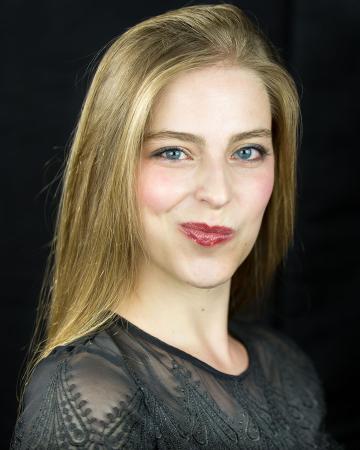
“I did not intend to go into music as my career, however. I watched my parents struggle, and I knew exactly how hard it was. My plan was to go to MIT, and become an astrophysicist, and maybe sing on Sunday mornings or join a community choir… Thank God, that isn’t how it worked out. I went to Columbia instead, and I thought, “oh, maybe I'll minor in music,” which turned into a double major, which turned into just music.
“When I got to college, I spent my first year mostly at the local Greek Orthodox Church. Then, my sophomore year, I wandered into the teeny tiny OCA parish five minutes from my dorm, and they said, ‘Oh, you're a music student? Great, we need a conductor.’
“I was too stupid to know that I should say no, so I said yes. After that, I knew that I was going to be a musician. And I knew that church music was going to play into it.
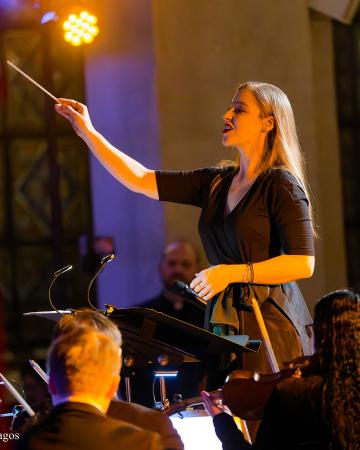
“Between undergrad and grad school, I did the ‘millennial thing’ and lived with my parents, and they happened to be in Cairo, where my dad was teaching. I sang, I conducted, I taught, I performed and did all manner of fun things, and then I came back to the States for grad school. During that time, I also sang as a paid professional for Catholic, Episcopal, and Anglican church choirs.
“I didn't realize until after I finished my master's and came back to the East Coast that Greek churches could also hire professional choral singers. It had never occurred to me that a Greek church might have a professional choir! In some OCA parishes, you're lucky if the choir director even gets paid, right? But I came back to New York and lived with my aunt, who is Greek and also a singer, and she told me that both Annunciation and the Cathedral paid professional choral singers. She encouraged me to reach out.
“I did, and I've been involved with the Cathedral choir ever since. I started subbing with them in 2017 (while singing at Annunciation!), and became a staff singer at the Cathedral in 2019. Around 2021, there was a change of leadership amid the COVID chaos; I became Associate Director of Music, and have been there ever since.
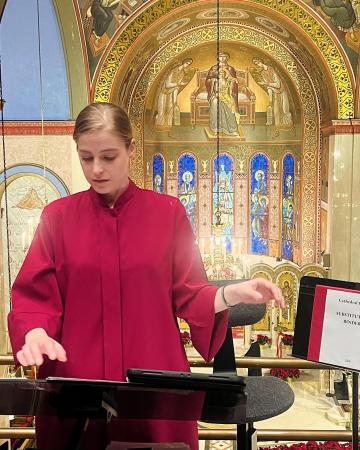
“As Associate Director, I'm "second in command" of the choir. I sing whatever part they need me to sing on any given Sunday. I'm also the administrator of their concert series, Great Music Under a Byzantine Dome, which hosts at least four concerts a year, if not more. We bring in orchestras for two of those concerts, and I'm responsible for many of the arrangements for those programs. We'll take chants and orchestrate them, or take a four-part hymn and turn it into something more complex... Alongside that, we'll also do Western sacred music and other interesting things.
“It is fantastic. The cathedral is very, very fortunate. My voice teacher in undergrad, Dr. Dino Anagnost, was the Cathedral's Director of Music for decades, and he founded and built the GMBD concert series, and similarly built up the choir. His work laid the foundation for the current program, and his high musical standards set the expectations for our music program today.
“We're also working on our music library, which is very exciting. The library collection houses primarily Orthodox composers, with a particular eye towards Greek and Greek-American works, as well as the broader Western repertoire, especially choral repertoire. A lot of that music gets passed directly from church to church, but there isn't really a single good repository of it. We are trying to build up a resource for researching, studying, and sharing the music of our traditions.
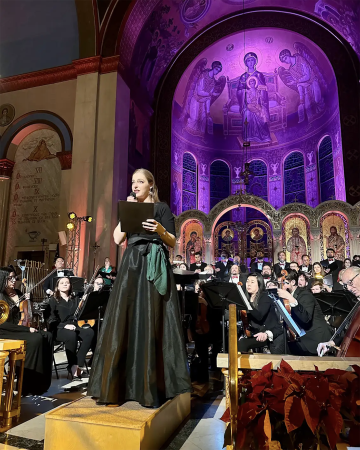
“So that's maybe fifteen hours of my week, and when I'm not doing any of those things, I'm the artistic administrator for a wonderful small opera company in Manhattan, Teatro Grattacielo. That’s twenty hours a week of wrangling singers and making schedules and begging people to please send me their tax forms. I also teach voice as an adjunct at Wagner College, which is a small liberal arts school in Staten Island. Besides that, I'll jokingly call myself a choral mercenary: I'm a section leader in community groups, I sub for different choirs, I work as a soloist. I'll sing wherever people are willing to pay me to sing.
“It's pretty typical for a musician to have many different jobs that they puzzle-piece together, and hope and pray that it'll actually pay their bills. I’m lucky that I’ve always had people I could ask for advice when I needed it: my dad, my family, teachers. A lot of my dad's students have helped me along the way.
“Funnily enough, it can be tricky sometimes to find Greek or Orthodox classically trained singers to sing with us on Sunday mornings. A lot of them, in order to pay their bills, will sing in other traditions instead. You sing for the Catholics, you sing for the Anglicans, you sing for the Presbyterians, because those are the traditions that are most likely to pay their choral singers well. It's been a process, trying to nudge Greek singers back and say, ‘Hey, come sing in your tradition. Come sing in the language that you pray in. Come sing the music that you grew up in.’
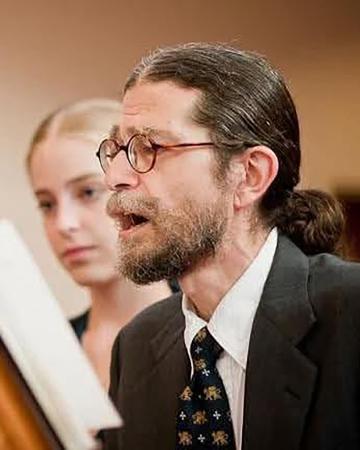
“At the Cathedral, we have a standing tradition of really excellent music and a really incredible choir, as well as world-class chanters. Our choir is half pros and half volunteers. Particularly at the cathedral, I wonder sometimes if people would like to join the choir, but get a little intimidated…?
“If this is how you feel in your parish, my advice is: try it. Just try it! Walk up to the choir director and say, ‘How do I get started? How can I try this?’
“It's not as hard as you think it is. It's also a lot more fun than you think it is. And I think it's one of the most rewarding ways to exist in the church. Particularly as a kid, it was amazing to grow up embedded in all of that tradition and theology, not to mention the community! Some of my earliest memories are of my dad holding me while he was chanting. These are the things that plant themselves into your soul. If you’re a parent thinking, ‘Oh, I have children to wrangle; being in the choir is not really realistic’...it actually might be possible. Especially if they're a little bit older, and they can follow along a little bit, and you're willing to be patient with them and help them — it’s one of the best ways to really draw your family deeper into the church, and to build that really strong relationship. (It's also a great reason to support your parish's youth music program, or to help create one!)
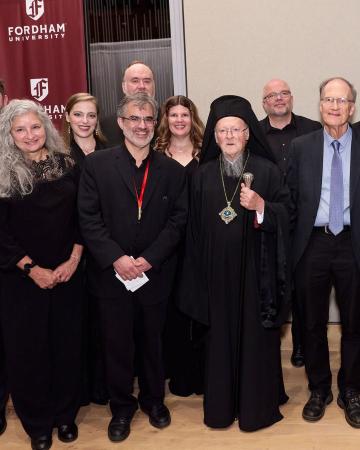
“The other thing I would want people to know is this: it's a lot of work, and time, and resources. We put a lot of effort and preparation into the music each week. Supporting your music ministry, whether that's by singing, or by donating to it, or by advocating for your parish's music ministry: these things are really crucial, to all of us as human beings and to the health of your parish. A parish with good music is somewhere that people want to come. I can't overstate the ripple-out effect that it has. But for this to be the case, your music leaders have to know what they're doing. Churches have to be willing to support that training, honor that expertise, and pay for that time.
"One of the most important things my father taught me, something he repeated over and over to his students and his choirs, is that music makes us more human, in that it draws us closer to one another, and it brings us closer to God. Fostering excellent music in our parishes is absolutely crucial to our spiritual well-being.
“Music is one of the few areas, across all religious denominations, where people don't always consider that those who serve need to be paid. People assume that you must do it because you love it. And we do! But unfortunately, weekends are when musicians can generally get paid the most. Many singers therefore feel the need to go to where they will be paid, and that's why so many Orthodox musicians are not in their home churches. Churches pay their accountant and their janitor, so why would they not pay their musicians?
“In our choir, most of our professionals are trained opera singers. Many people don’t realize that singing an opera is the physical equivalent of running a marathon. It is a huge effort. Singing two hours of pretty strenuous Orthodox Church music is basically an opera every Sunday morning, and people don’t fully realize that that's what they're hearing! It's incredible.”
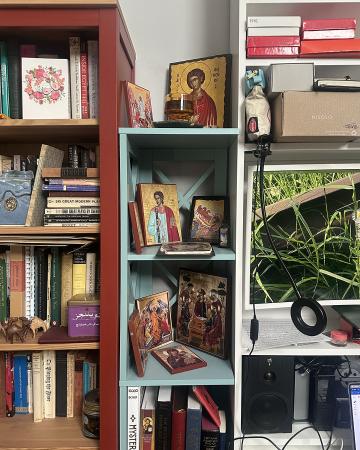
As always, we asked our Woman of the Week, Hilary Baboukis, to tell us about her morning routine:
“I am going to make the argument that, per Biblical tradition, my day actually starts in the evening! To be honest, I am the night owl's night owl. I am at my best starting at about 10 pm. It's a running joke with my boss at the Cathedral that, during concert season, he'll receive orchestra scores at 3 o'clock in the morning, and they'll be far better than the scores that he would get if I finished and sent them at 10 am.
“Nighttime is when I get my life together. I have the time and space to actually pause, and think through the day that's ending, and plan for the day ahead. I have time to read my Bible. I have time to pray. And then the next morning, when the alarm goes off, and I’m hauling myself kicking and screaming out of bed, pouring coffee down my throat and flinging myself into whatever comes next: none of that would be possible without my preparations the evening before. So I would say my day starts around 1 am or so, give or take…which is technically morning, so there you go!
“But, of course, this does not always work with a modern schedule. On Sunday mornings, the choir is called at 9 am, which means I'm trying to get to church around 8 to print music, organize binders, check in with my colleagues, and make sure everything is good to go. To get to the Upper East Side a little past 8 am, I leave the house at about 6.30. It is not a kind schedule for a night owl. But the nice thing about being a musician is that we do have a lot of evening commitments. A lot of rehearsals and concerts are, of course, in the evening, so that part works just fine.”
Thank you, Hilary!