Anastasia McCune
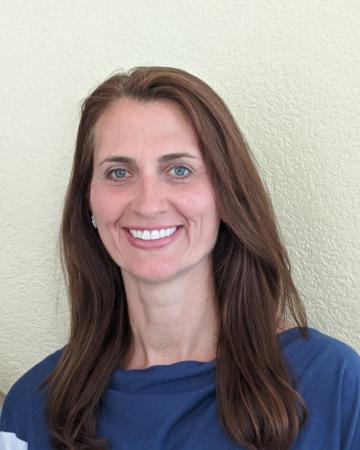
Anastasia McCune is our Woman of the Week, nominated for her work as an instructional designer and as a newly-licensed commercial pilot. We asked her to tell us how she got from where she started to where she is today:
“I would say it began at graduate school at the University of Denver. I chose Digital Media Studies, which may not even exist anymore as a degree. It covered any kind of digital media: programming, visual design, website building, etc.
"I really enjoyed it, and I learned how to see and speak in visual design terms. At some point I picked up an animation program called Adobe Flash, which is now called Adobe Animate. I began doing a lot of animation work – not on big projects like movies, but things like banner ads. I swear, if I ever look at another Big Mac again, I will not be able to eat it, because I animated so many hamburgers coming in with steam coming off, and that kind of thing!
"Adobe had a program where you could take an exam, go through a training class, and then you could teach their software. That's what I ended up doing. I later learned to use their e-learning software, called Captivate. Eventually I was teaching Captivate as well and realized that I was really interested in the design of courses and instruction. This led me to work at Regis University in Denver as an instructional designer. I’ve been working in that field now for twenty-five years.
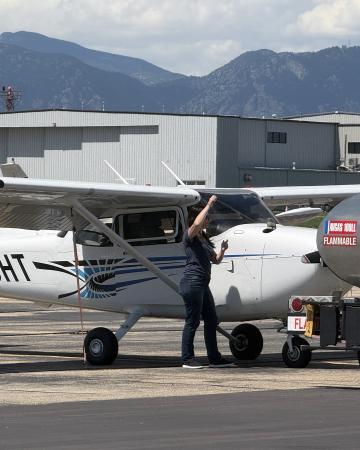
"I love it. It's so much fun. I get to work with subject matter experts in all kinds of areas and learn about all these different domains. But in the end, I’m working with them to design a curriculum or a course. Some subject matter experts are really good at that. But sometimes people struggle to explain their vast breadth of knowledge - they have done it for so long, they forget what it was like to be a beginner. I find it fascinating to help others translate their knowledge into a well-designed course.
"It's been a wonderful career, and it continues to be. I enjoy teaching online, and I enjoy speaking. But on Labor Day 2020, my family took a helicopter ride at Mount Rushmore, and in that moment I thought, ‘Where has this been all my life?’ I decided that I had to pursue training to become a pilot.
"I've been flying now for about four and a half years. It took a while. When I began it was during COVID, everything was closed, there was nowhere to fly. I also had to save some money, that kind of thing. So it took me two years to get to the first level, private pilot, where you can just fly yourself and maybe a few passengers. Two years is a very long time compared to some, but that's what I could make possible while working around my career and family.
"The next step up from private is instrument certification, which is where you're flying solely in reference to the instruments in the airplane itself. And now, just a few weeks ago, I received my commercial pilot’s license. With this license, you can be hired to fly. You can do any number of things: tow banners, drop parachutists out of the back, do surveying for the Forest Service, instruct – the list goes on. When you get enough hours, that’s when you can get jobs flying commercial airlines.
"I’ve realized through the process that I love flying, but there's so many other things that I can aspire to in aviation besides just fly big jets. I can teach, I can be an instructor, I can develop curriculum. I’m working on becoming an instructor next. I’m excited to see where things go from here to combine my expertise and experience.”
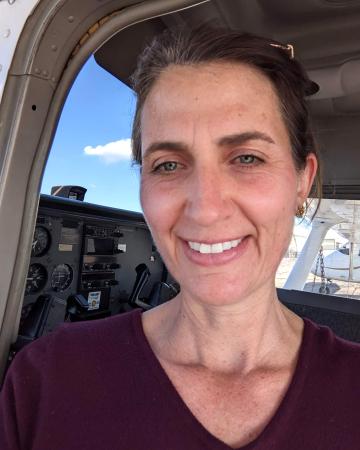
We asked Anastasia to tell us what she would like people to know about what it’s like to be a female pilot:
“I think we all need a community of practice. For me, many times in life that has been the Church. That’s probably true for many of us – whether we’re involved in Philoptochos, or are helping out in Sunday school, helping with baking Prosforon for communion, or are faithfully attending liturgy, that community of practice affects every aspect of our lives. It affects not only what we're doing on Sundays, but the way we think and the way that we approach every day.
"The community of practice for women pilots is found in organizations like The Ninety-Nines, which was created by Amelia Earhart and 99 of her pilot friends in 1929. At the time, I think there were 114 certificated women pilots. They hosted the Powder Puff Derby race for women as a way to create community. And they have continued as an advocacy group today, which is wonderful when only 11% of pilots are women.
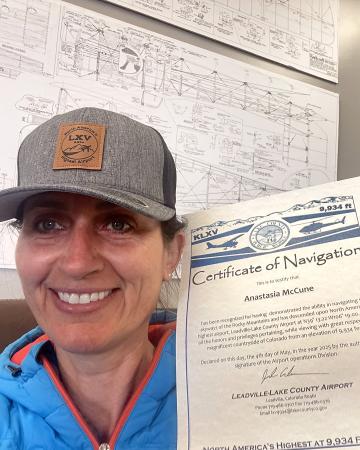
"When you're just starting out in anything, you’re looking to a community of practice to figure out what's going on, and how you fit in. And that's what the Ninety-Nines was for me. I told another more experienced pilot, ‘It's taking me forever to get to private pilot. Nobody takes as much time, or spends as much money as I do, and I'm still not there.’ She responded, ‘Don't worry about it. When I started as a private pilot, it took me a similar amount of time, because that's what I could do. I was busy taking care of my family. You will get there when you get there. Learn it fast, learn it slow, just learn it well.’
"That helped so much, just to hear somebody else say that, and give me permission to be who I was. That's what I think is so important about a community of practice. It helps you go from asking for permission to realizing that you can do it yourself. And for me, that was a very big part about becoming a pilot. I had to teach myself to not ask permission from my instructor, or ask myself, ‘Do I even belong here, can I even do this?’ I had to get to the point where I was the pilot in command.
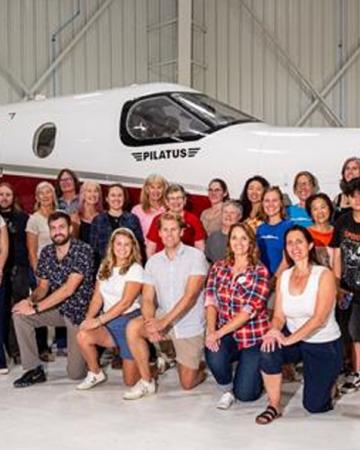
"It makes me think about the women in my past, and the stories they told me. I remember talking with my grandmother and my great-grandmother about their journeys as immigrants coming to this country, and of course that's a fearful thing. You don't know what you're coming up against. My great-grandmother was illiterate in Greek and in English, and the community of practice that she had was the Church. Even now, there's all this cultural stuff that's there in the back of my head, telling me, ‘You should be afraid, you should be afraid.’ I’ve had to work past that, because when you're a pilot in command, you can't be afraid. You have to be the one calling the shots.
"Whether it's as an Orthodox woman, whether it's as a pilot, or whether it's in your career, I truly believe it's about the community of practice. It’s so important to find others that are doing the same things that you're doing, that may have read books that you haven't read and can provide you support from a perspective that you can relate to. That human aspect is why groups like Axia Women are so needed. If you feel alone in anything, you have to find somebody to talk to. You need someone to ask, ‘Can you help me figure out the next step?’ I think all women should feel safe seeking out the community of practice and others like yourself who you can learn from.”
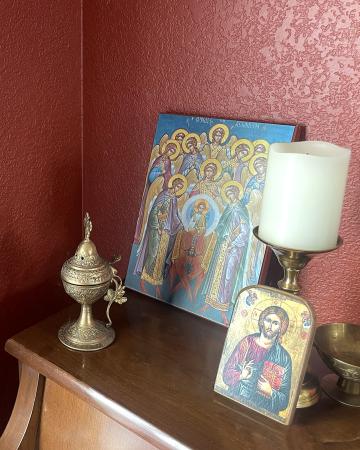
As always, we asked our Woman of the Week, Anastasia McCune, to tell us about her morning routine:
“During the school year, my routine is usually this: First, I get up and make my daughter's lunch, because I should have made it the night before, but I don't. I help her get ready and out the door to school. Then I come home, eat breakfast, feed the dogs, and do a bit of meditation and prayer. It's usually about 10 minutes or less, because that's what I have time for. But even that amount of time has made all the difference in my life.
“My grandfather was a chanter in the church. He learned in Greece and chanted his whole life.
His life project was to transcribe the hymns from Byzantine notation into Western notation. I remember him doing that every day in his basement. After work, he would go down and he would work on them. Many different churches would write to him and ask if he could translate the hymns for a particular saint or feast. All that work is available now, and a lot of churches use it. Of course, he wasn't the only one - there were other people doing similar work, but the time he spent chanting and meditating on the hymns each day formed him into a certain kind of person.
“He was the calmest person I knew. My Yiayia would be going crazy, and he was just calm and cool. Even into old age, when he unfortunately suffered from dementia, he never became combative. He just said he could hear the music in his head all day long. I believe it made a difference in who he was to constantly think about not just the notes that he was singing, but the message behind them.
“Maybe someday I'll be a chanter, too. But that is one reason I try to begin each day with those ten minutes before I jump into the busyness of work and everything else: the idea of having that constant presence. Just knowing that the presence of God is there, even if you're going crazy, and you're late to a meeting, and all that stuff: it's still there. It gives me a ten-thousand-foot view, I guess you could say.”
Thank you, Anastasia!