Women of the New Testament
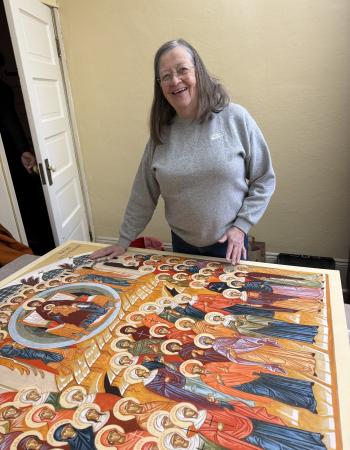
When iconographer Heather MacKean was commissioned by the University of Portland to compose an icon of women in the New Testament, they emailed her a list of 18 names. Several months later, 18 had grown to 20, then 24, and finally to 58!
“I had no idea when I started that there would be so many names,” Heather commented when we spoke to her this week about her newly delivered icon. “If I had more time I might have come up with ten more women.”
While conducting research for the commission, Heather says she learned about many new-to-her female saints in the days of Christ and the early Church. Women who were not named in the New Testament retain a name in the Orthodox tradition - such as St. Bernice (the woman with the flow of blood), St. Claudia (the wife of Pilate), St. Photini (the Samaritan woman) St. Candace (the Queen of Ethiopia), and St. Junia (who is said to be one of the seventy apostles sent out by Christ). And then there were the dozens of women involved in the early Church - supporting the work of the apostles, hosting home churches, caring for the poor, becoming unmercenary healers, suffering martyrdom, and preaching the good news.
“When you start researching it, you realize there were hundreds of women involved,” Heather said.
Eventually, she set herself a cutoff criteria: women must have chosen to follow Christ in the first century, either as a result of an encounter with Christ, or through one of the Apostles. Even then, the list kept growing. “A month before I was supposed to deliver the icon, I learned that St. Photini was martyred with her five sisters, so I added them in,” said Heather. “Then I found out that St. Photini converted Nero’s daughter, Domnina, who brought one hundred of her slaves to the faith. I couldn’t add in that many faces, unfortunately!”
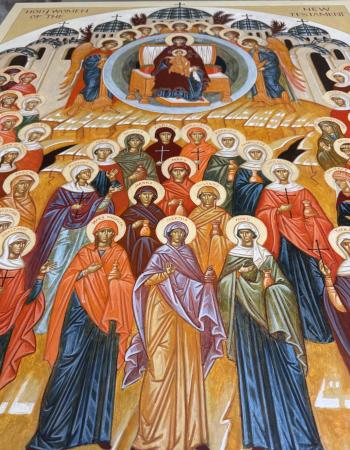
To accommodate the growing list, Heather had to change the design of the icon three or four times as well as the size of the icon panel. Eventually she ended up with a piece four feet tall and over three feet seven inches wide - and she was still running out of space. For the composition of the icon, she chose to follow the model of one of her favorite icons, “In Thee Rejoices.” The Theotokos is in the center in a mandorla with Christ enthroned on her lap, the Church and Creation around her, as a picture of paradise.
“I was really amazed to hear the story of St. Photini,” Heather remarked in connection with this image. “She was known as Equal to the Apostles, one of the greats in terms of preaching, and imprisoned for three years with her family. They turned the whole prison into a paradise. It smelled like myrrh and incense; they healed those who had been blinded by the guards, and it was filled with lots of rejoicing and praise.”
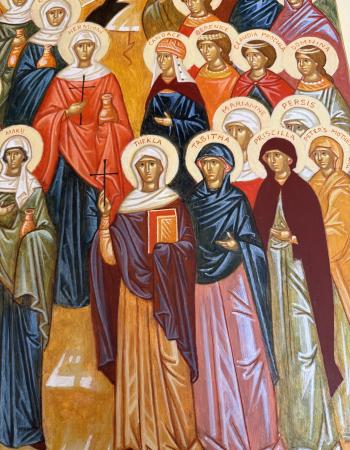
To honor women’s role in sharing the Good News, Heather chose to put the Myrrhbearing Women front and center of the icon, below the Theotokos.
“I was also surprised at how many women preachers there were, I was not expecting that,” she commented. “Women like Thekla, Syntyche, and Euodia, they were sent out by Paul to preach - and not only to women.”
The icon is now being held at the University of Portland chapel, where it will be blessed before residing in the chapel of one of the female dorms.
Heather kindly shared her list of women in the New Testament (not counting the Theotokos) with us:
Anna the mother of the Theotokos
Elizabeth the mother of John the Baptist
Prophetess Anna, who witnessed the Presentation of Christ to St. Symeon in the Temple
Widow of Nain whose son Christ raised from the dead
The poor widow who gave the 2 mites in the temple
The wife of Jairus and daughter of Jairus
Peter’s mother in law
Junia who was one of the 70 apostles
Apphia who was also one of the 70 apostles. She was the wife of Philemon, the first bishop of Gaza. And was martyred with her husband.
The Mother of Rufus (and Alexander)who was probably the wife of Simon of Cyrene. Paul commends her as his “mother” because of her loving maternal care for him
Lydia who was baptized with her whole family in Philippi by St. Paul. She is considered by the Orthodox Church as “Equal to the Apostles “
Chloe of Corinth who alerted St. Paul to the divisions in the Corinthian church
Persis who St. Paul calls a beloved friend and commends her for her hard work for the church
Thekla who was converted by St. Paul. She is also considered to be “ Equal to the Apostles “. She worked with Paul and Barnabas to spread the Gospel . She lived for many years as a hermit in a cave in the desert. She is considered to be the first female martyr.
Syntyche and Euodia who were co-workers with St. Paul at the church in Philippi
Priscilla who with her husband Aguila were fellow tent makers and worked with St. Paul to spread the Gospel.
Eunice, St. Timothy’s mother
Lois, Timothy’s grandmother who St. Paul commends for her sincere faith
Nympha, who St. Paul mentions in the Gospel
Phoebe the deaconess
Mary the wife of Cleopas and mother of John Mark who had a church in her home
Mary of Rome who treated St. Paul with tremendous kindness
Basilissa and Anastasia who were converted by Sts. Peter and Paul and became martyrs
Damaris who is considered to be the first Athenian woman converted by St. Paul
Julia who is mentioned by St. Paul
The Syrophoenician woman who asked Christ to heal her daughter who was afflicted by demons
Tryphena and Tryphosa commended by St. Paul for their hard work for the Lord
Zenaida and Philonella who were cousins of St. Paul. They provided free medical care to the sick.
Berenice and Drusilla who were daughters of Herod Agrippa and converts to the faith
Claudia who was the wife of Pontius Pilate
Candace the Queen of Ethiopia
Photini- the Samaritan woman at the well who converted her whole family after her encounter with Christ. She is also considered to be “Equal to the Apostles”. She was martyred with her 2 sons and 5 sisters- Anatole, Phota, Photida, Kyriake and Paraskeva
Domnina the daughter of Nero who was converted by St. Photini. Domnina brought into the faith with her a hundred slaves.
Rhoda
Mariamne the sister of the apostle Philip
Enkhidia, Charilene and Hermione were Philip’s 3 daughters. They were prophets and unmercenary healers. Hermione also became a martyr.
The 7 Myrrhbearing women- Salome, Joanna, Mary, Susanna, Martha and Mary ( who were the sisters of Lazarus) and Mary Magdalene from whom Christ cast out 7 demons.
(After I varnished the icon I found out that Dorcas and Tabitha are the same person. And I also found out that the woman with the flow of blood was named Bernice. So the next time I am in Portland, I would like to change the name of the woman currently labeled Dorcas to Bernice.)
Thank you, Heather!