Three Holy Harlots: Finding Truths Among the Tropes
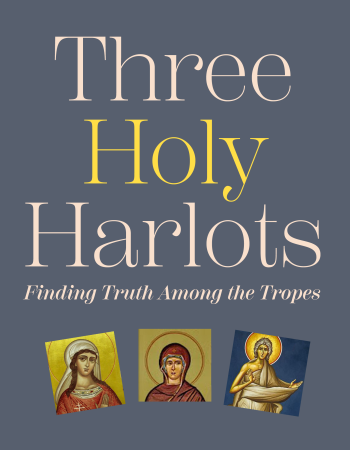
In recent months, I have had the joy and privilege of seeking out prayers of Orthodox women, ancient and modern, as a researcher for Axia Women. In the process, I kept running across the argument that Orthodox writings about our saints’ lives tend to remove those saints’ individuality by fitting them into certain types. The real historical persons, so the claim goes, are erased in favor of the kinds of stories we want to tell, and the moral points we want to make.
I couldn’t get this idea out of my mind. How much of our hagiography is just our favorite tales, told and retold, moral literature masquerading as biography? I have now read hundreds of lives of Orthodox women saints, and there is no denying that certain stock figures and narrative formulas appear again and again: the beautiful virgin who refuses to marry a pagan, for instance, or the cross-dressing nun who passes for a monk. Patterns emerge, themes with variations.
Yet, I am convinced that traces of individuality remain even among the most powerful tropes. A compelling case study can be found in the stories of saints who fall into the type of the “holy harlot,” the woman who turns from prostitution to intense asceticism and repentance. Several examples of this type emerged in Syria-Palestine and Egypt in the fourth to seventh centuries. But these women could never be mistaken for one another. Their words and actions, as sinners and saints, reveal strikingly different personalities finding their own ways to God.
Take Mary of Egypt, the most famous—and infamous—of these “holy harlots.” In the seventh-century account of her life, we first encounter Mary as an aging, wonderworking desert ascetic. But her early life, as she herself recalls it, was one of wild sexual activity, bordering on compulsion. I have heard a few interpreters assert that Mary must have experienced childhood trauma to pursue a life of such promiscuity. This simplistic cause-and-effect, however, isn’t true for all sex workers, then or now, and Mary’s own words leave little room for that conclusion. Mary insists on her own reality, her own agency, choices, and motivations: She loved what she did, and usually did it for free. She was driven by pleasure, not pain. She seduced men for the fun of it, and slept her way to the Holy Land because it sounded like a good time.
Contrast this with Pelagia of Antioch, whom we first see riding down the street in haughty splendor, stunning all with her beauty and finery. In the world of late antique sex work, Pelagia is an apex predator. She is educated, literate, sophisticated, a luxury commodity for the elite—an actress-slash-courtesan so successful that even her slaves are decked out in gold, who herself wears so much jewelry that the city knows her only as “Pearl,” her real name forgotten.
And then we have another Mary, known as the niece of Abraham, tied forever to the name of her sainted uncle. Raised by Abraham in an adjacent prayer cell, this Mary is a quiet, gentle young woman of heartbreaking innocence who is slowly groomed by a predatory monk, and then, after being seduced, despairingly believes herself so ruined that she is worth nothing more than prostitution at a city brothel. When her uncle finally comes to find her, we witness her, still meek and obedient, ready to offer whatever men want, trapped in another kind of cell.
Here's what I love most about these stories: They show us that the shape of the sinner is the shape of the saint. These women’s singular characters persist through their conversions and into their later ascetic lives. Mary of Egypt remains bold, eager, passionate: The same woman who threw elbows trying to get into a church to see the True Cross, fights day and night in the desert to be saved by it. Pelagia, cultured and skillful, debates her way into baptism: For, as she persuades a roomful of learned bishops, just as Christ their God received sinners, so should they. And Mary, Abraham’s niece, simply and humbly agrees to go home.
So much more could be said about these “holy harlots.” But maybe their own words, the prayers we attribute to them, are their most potent testimony. Hear Mary of Egypt, who rushes to an icon of the Theotokos and shouts out, “Lady, lady, do not abandon me!” Or Pelagia’s words at her baptism, so eloquent that they seem like part of the rite: “I acknowledge you, Christ, and your Father, and your living and holy Spirit … I renounce the falsehood I have wrought, and the prostitute’s profession I have been following up to now.” Or sweet Mary, weeping in gratitude for God’s mercy, “What shall I render to Thee for all this, O Lord my God?”
How historically accurate are these stories? Some saints’ lives are better documented than others, but often, it’s impossible to tell. Ancient tales get mixed up and mixed together. Details are lost, and well-known tropes fill the gaps. But, far from erasing individuals, I believe our hagiographical tradition does what it can to preserve and commemorate them. Through the type of the repentant “holy harlot” we glimpse a party girl, a savvy businesswoman, and a wounded innocent—three enduringly distinct women, remembered in our songs and prayers from generation to generation. They teach us that the devil is defeated in the details: that we, too, will find our own ways to God, not as some generalized holy “type,” but only as ourselves, honestly present and honestly seen, with our own histories, our own mistakes and day-by-day struggles, and our own prayers from the heart.
So as we walk through Great and Holy Lent, let us remember the unique women who went before us and pray that we might follow their paths by finding our own. And through the prayers of our holy mothers, may the Lord Jesus Christ, our God, have mercy on us and save us.