Sister Cecelia on the Annunciation
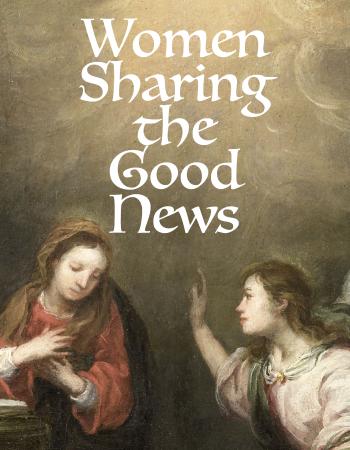
We had a wonderful eight weeks with Orthodox women across jurisdictions as part of our Women Sharing the Good News course which concluded recently. The theme for this course was "Saying Yes to God: Courage and Choice in the Lives of the Theotokos and St. Mary of Egypt." Over the next couple of weeks, we’ll be sharing a selection of participants’ final pieces with you. Our next is by Sister Cecilia on the Annunciation:
Have you ever wondered what Mary’s life was like from the time she was brought to the temple at 3 years of age and after she was betrothed to Joseph and brought to his house? Scripture does not really give us much real information. But we can use a little imagination. The icons depict Mary being escorted by the angels to the holy of holies, indicating perhaps that she was especially blessed and would encounter God in the Temple. Being only 3, there must have been other widows like the holy Anna who cared for and instructed Mary in what we might call -- holy living and the history and covenant with the God of her people. Was it normal for the ones dedicated to God to be prepared for a future life outside of the temple as Mary’s betrothal indicates?
How did Mary spend her days up until her betrothal to Joseph? Icons have generally depicted Mary working with a spindle, generally sitting when seeing the angel. Gabriel’s greeting “O favored one”, Mary found perplexing and wondered what it meant. Gabriel knew his message could be very frightening so he tried to calm and reassure her that she had found favor with God. Then the shoe fell: she would bear a son and name him Jesus (meaning Savior). He would be called Son of the Most High, reign over the house of Jacob, and his kingdom would last forever. What a wonderful message but how many questions Mary must have had.
It would seem that the instruction Mary had received during her days in the temple helped her to realize what a responsibility if she said yes to this announcement.
According to Apocrypha in the Syriac tradition, deciding to accept the divine request for the use of her womb after a lengthy interrogation of Gabriel, Mary decides when she is ready. Cleaning and decorating herself are her choice and” Here am I” indicates “Let my Lord come”. Mary was free to choose. St Cabasilas stated “God persuades, God does not compel”. God knocks on the door, but does not break it down”. Mary is chosen by God, but she herself…makes a choice when she says yes. She responds with dynamic liberty. As St Paul says “not just a pliant tool but an active participant in the mystery. Bishop Kallistos Ware has written of Mary: “What we see in her is not passivity but engagement, not subordination but partnership, not submission but mutuality of relationship.”
“Behold I am prepared so that according to His will He might dwell in me”.
Mary’s initial response to be Jesus’s mother was to travel to Judea from Nazareth to help Elizabeth for 3 months before giving birth to John.
A poem by Denise Levertov illustrates what Jacob of Serug wrote of Mary “Mary turns to the task of preparation by refining and cleansing her senses...and mind.”
“Mary poured out as oil, good deeds in her lamp and her great flame has been inflamed in the temple of her body.
She burned the fragrance of her prayers warmly, so that the pure fire of her faith should serve as incense.
She threw, as sweet spices, the sounds of praise into the fire of her love and from her thanksgiving breathed the fragrance of choice incense.”
Mary directed every aspect of body, mind and soul to the holy one within. Her prayer was not an activity undertaken for a few hours each day; her life continually turned towards God. Daily we have opportunities to love. Do we recognize them? Daily quiet meditations enable us to increase our desire to embody Christ in our lives. While recognizing that our bodies are temples of God, the most mundane of moments are opportunities to express our love.
In the book “Church of our Granddaughters”, Carrie Frederick Frost wrote: "The mind and spirit are intimately involved, but the workshop of deification is the body. God became human, became embodied, in order to experience a new intimacy with us, so that we might experience a new intimacy with God—within and through our bodies." Or as Dina Zingaro phrases it, "Our body is the workshop of our Theosis."
As Theologian Lev Gillet has written:” All of life, each act, every gesture, even our smile can be an act of love.” This Lent have we undertaken to see our bodies as temples of God? If not, it is never too late to make it a beautiful dwelling as Mary did for Jesus.