The Several St. Aureas
We don’t often get to see the evidence of our lives woven in and amongst our sisters throughout history. Yet over the course of several hundred years, the Church has come to celebrate several saints this week who are all named Aurea, or “golden” - women whose lives form a golden chain across status, century, and country of origin to form a tapestry of faithfulness.
St. Aurea of Ostia
You could say that St. Aurea of Ostia’s life began at the point when others thought it was ending. Exiled from Rome for her faith in Christ, it is traditionally believed that she came from a wealthy, royal family. Were they shocked by her faith, this golden daughter choosing a life outside of their comfortable provision? Did they renounce her, or did they send her with their blessing?
However it happened, St. Aurea was sent to Ostia, on the coast of Italy outside of Rome. There she lived on an estate outside of the city walls and maintained contact with local Christians.
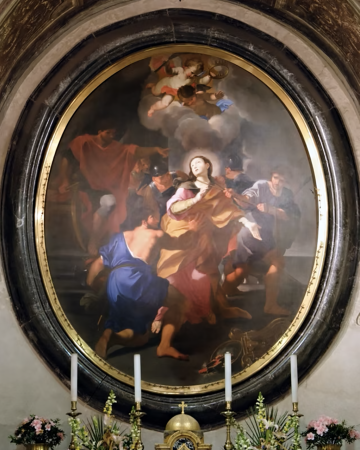
We know that St. Aurea was visiting other Christians in prison because of a miracle associated with her. One day, she went to visit and comfort a Christian prisoner named Censorinus. During her visit, his chains miraculously loosened. Seventeen soldiers converted to Christianity as a result of this miracle, and were later beheaded. Not long afterwards, after the report of several other miracles, St. Aurea was tortured and then thrown into the sea with a stone around her neck. Her relics were found and buried on her estate in Ostia, where a church was later built.
A fragment of a Christian inscription that refers to Aurea was rediscovered near Santa Aurea in 1981. It reads CHRYSE HIC DORM[IT]: "Chryse” (or “Golden”) sleeps here".
Some calendars celebrate St. Aurea in August or May, but she joins a golden link in a chain of witness that continued several hundred years later…
St. Aurea of Paris
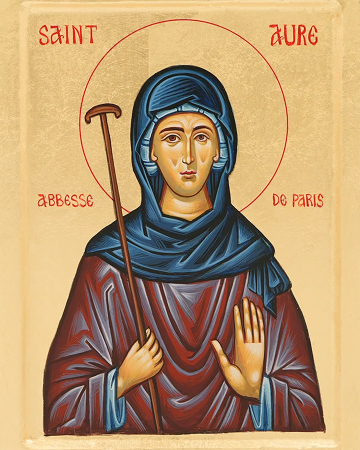
Several centuries later, another woman was given the name of Aurea. Although we don’t know if she was named specifically after the Saint of Ostia, it seems possible. What we do know is that this St. Aurea was an immigrant to Paris from Syria in the early 600s. When a women’s monastery was created around 632 (home to over 300 women), St. Eloi (also known as Eligius) appointed St. Aurea as the abbess.
Three hundred or more years later: three hundred or more women. What did St. Eloi see in her in order to appoint her to this role of leadership? And whether Aurea was given her name at her baptism or her monastic consecration, what wisdom and courage linked these two women across centuries?
For thirty-two years, St. Aurea faithfully led the women in her monastery. We can imagine her quieting disagreements, encouraging new novices towards virtue, comforting those who turn to the community at a difficult period of their lives. Perhaps she welcomed visitors hungry for a word of advice or made difficult decisions when food or finances were low. However it went, what we do know is that in the 660s, St. Aurea died with one hundred and sixty of her sisters of the plague which spread throughout Paris. Although not martyrs, we can imagine them still united by the knowledge of their coming death, encouraging one another to remain faithful to the end.
Today, Aurea's relics are held at the church of St. Eloi in Paris, where there is a mural of her receiving her monastic veil from St Eloi. We honor St. Aurea of Paris on October 4/17. The golden links in the chain continued…
Saint Aurea of Boves
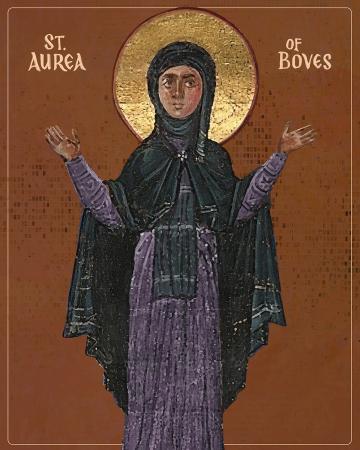
Less than two hundred years later, St. Aurea of Boves was born in Amiens, France, in the 8th century. Little is known about her family or early life, but it seems she was drawn to a life of prayer and contemplation from a young age. As soon as possible, she left home and became a nun in Boves, a small town in northern Italy. This convent was known for its disciplined and devout way of life, and word spread of St. Aurea’s unwavering faith, humility, and commitment to living a holy life.
Once again, we do not know if St. Aurea was given her name at baptism or at her monastic vows, but either way someone chose to name her “Golden,” in the footsteps of two women of courage, leadership, wisdom, and prayer who had gone before. Eventually, St. Aurea followed in her predecessor’s footsteps and was elected the Abbess of their convent. Tradition tells us that under St. Aurea's leadership, the convent flourished and attracted many new members due to her deep compassion and reverence, encouraging her fellow sisters to grow in prayer, self-discipline, and service to others.
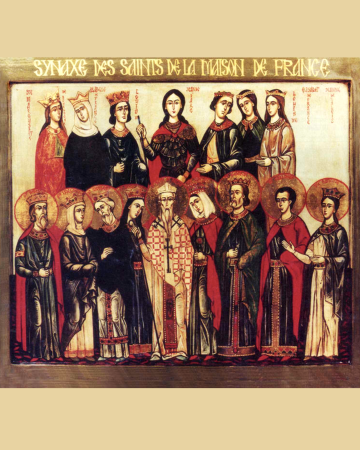
As St. Aurea’s reputation for holiness spread, she was invited by Christians in Rouen, France to come and help them build a monastic community. St. Aurea accepted their invitation, left her convent, and helped build a community in Rouen dedicated to prayer, humility, and selfless service. As a mentor and guide to her fellow sisters as well as many local parishioners, she was greatly respected and admired throughout the region. She was known for not only spending many hours in prayer, but for service to the sick, the poor, and the marginalized.
St. Aurea died in peace and is continued to be honored today for her selfless love and unshakable devotion to God. Across status, century, and country of origin, her life joined with those who had walked the path of faithfulness before to form a tapestry of grace in which we continue to walk today. We celebrate her memory on October 6/19.