Sensitivity and Boldness
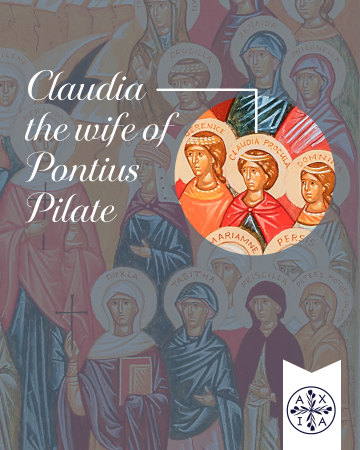
“Have nothing to do with that just man, because I have suffered many things in a dream today because of him” (Matthew 27:19)
St. Matthew is the only Evangelist to mention the wife of Pilate, and the dream she experienced the night Christ was brought to trial. Although in this account she is not identified by name, in the apocryphal Gospel of Νikόdēmos she is called Procla, or Procula. By the late fourth or early fifth century she was traditionally known as Claudia Procula.
Over the centuries, there have been countless speculations by poets, playwrights, painters, and filmmakers about Claudia’s life and the nature of her dream. As much as we would love to know what was revealed to her that night, in Matthew’s writings the emphasis is not on what the revelation was, but her response to it. She was perceptive enough to recognize a moment in history when all of heaven waited with bated breath, astonished at the unjust trial of the Son of God. While Pilate was asking his famous question, “What is truth?” Claudia had the courage to take action. Her message to her husband was a clear statement: this man is innocent, and to ignore this truth is causing immeasurable suffering.
In some versions of the Gospel of Nicodemus, both Pilate and Procula are depicted as present at the crucifixion, and so anguished by Christ’s death that they cannot eat or drink. Both, in their own ways, must have recognized the terrible rending of time and history that occurred when Christ died. But thankfully, Claudia (and possibly Pilate) were not left there, in regret and terrible sorrow. Tradition tells us that after Christ’s death and resurrection, Claudia embraced Christianity and received baptism. While different traditions hold her as either a martyr or simply a holy woman who died in peace, she is commemorated as a saint across the Greek, Coptic, OCA, Ethiopian, and many more traditions.
St. Claudia accompanies us today as a woman of both sensitivity and boldness - able to discern truth with an intuitive receptivity, and courageous enough to take action with what she saw. Incapable of preventing the tragedy she saw unfolding, her soul must have erupted with joy at seeing the Resurrection turn even her greatest remorse into good.
In Heather MacKean’s icon of the Women of the New Testament, St. Claudia is on the right-hand side of the icon. A high-quality 8×10 print of this icon, produced on heavyweight, acid-free cardstock with a matte finish, ready for framing, is our thank you gift to everyone who donates $100 or more—or a monthly commitment of $10 or more–to our Myrrhbearing Women Fundraiser.
If you are already a monthly donor, thank you! Any amount you are able to increase your donation will come with a thank-you gift of an icon to your mailbox! Your support directly makes possible gatherings, scholarships, and resources that enable Orthodox women to come together across differences, deepen in faith, and find the encouragement and training they need to live out their callings in the Church.