Friday, September 18, 2026
Reflections on the Feast of the Exaltation of the Holy Cross
Image
Image
Text
Rejoice, O life-bearing cross!
We celebrate the Feast of the Exaltation of the Holy Cross on September 14/27, honoring the finding of the Holy Cross by St. Helena and the miracles it worked. One of the beautiful traditions that has sprung up amidst this feast is the decorating of a parish cross with flowers, basil, and other greenery and herbs.
You only need to scroll through a Facebook group like Flowers in the Orthodox Church to see the wide variety of expressions of this tradition. From placing the cross in a bed of basil and roses, to creating elaborate garlands and centerpieces, to using flowers to form the actual shape of a cross, these arrangements are a beautiful picture of the diversity of our Orthodox expressions. Everyone’s cross looks different, but we’re all celebrating the same feast.
Years ago, I was delighted to experience the joyful celebration of my first Feast of the Cross. Before, I had often thought of the cross as something stark, solemn, and sad. And while we certainly allow the sorrow of the Cross to penetrate us during Holy Week, these feasts of the Holy Cross remind me that is not the whole story. Adorning the cross with flowers and herbs is a visible reminder of what we sing in our hymns: that the Cross is fruitful and life-bearing, not just an instrument of death. What looked like defeat was really an “invincible weapon of peace” to conquer the enemy of death - for which we can rejoice.
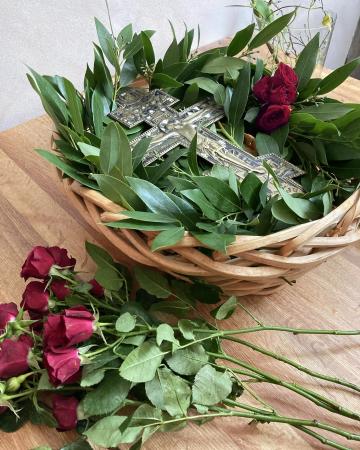
I wanted to learn more about this tradition of decorating the Cross, so I asked the women in my parish who serve in this way to let me watch their work. In our parish, we often place the cross in a basket filled with bay leaves, then adorn it with olive branches and roses. You can see the process in the photos here. The entire basket is then placed on the icon stand when the priest brings it out for veneration.
Many other traditions incorporate basil instead of bay leaves, as it is believed to have been flowering at the site where the Cross was found. The name itself means “royal plant” or “king” (if you know any women named Vasiliki, they are named after this plant!) Bay leaves are also symbolic of victory, and of course olive branches are symbolic of peace. Many parishes use red roses to symbolize the blood of Christ, or a mixture of red and white, but I have also seen beautiful arrangements with lilies, carnations, and many other flowers.
“For through the Cross joy has come into all the world” - and how can we not feel joyful when the physical presence of the Cross, and indeed our entire Church, is filled with such beauty, scent, and light? For “Christ has brought us back to life!” (from the hymns for the Exaltation of the Holy Cross)