An Orthodox Woman’s Pilgrimage to Rome
Rome: the Eternal City. Although the modern pilgrim will encounter a thick layer of more recent Catholic history (Baroque-frosted churches and statues come to mind), travel one floor deeper, and you will find endless remnants of our earlier, and shared, Christian past. Sometimes this is literal: many churches have excavated beneath their floors to find ancient churches, homes, and crypts beneath. Other times, we may need to metaphorically peel the layers back to uncover the more ancient history within.
I was reminded of this fact last month after spending a few days passing through Rome on the way to other destinations. What stayed with me most were the many different female saints I had the opportunity to meet during that time, and whose lives became infinitely more real to me after this encounter. The women of Rome’s early Church were active, generous, and bold. Some were wealthy; others came with only their burning hearts to offer, but all gave themselves to Christ at great cost. Without them, the history of the Church would have looked much different – and been much poorer.
St. Cecilia of Rome
For you made music in your martyrdom,
In all your three days dying you made room
For beautiful abundance, gifts and giving,
Your death was blessing and your passing praise…(Ode by Malcolm Guite)
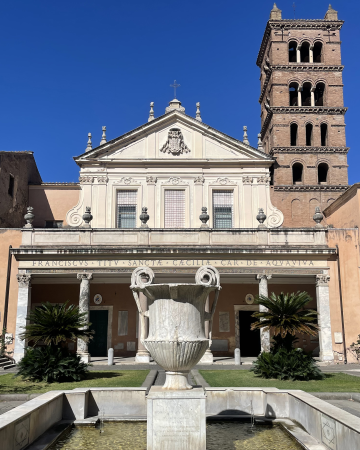
The child of wealthy and illustrious parents, St. Cecilia was born in Rome in the 3rd century and raised in the Christian faith. Throughout the community, she was known for praying fervently and helping those in need. Today, we remember her as the patron of music as well as for her courageous faith in the midst of martyrdom.
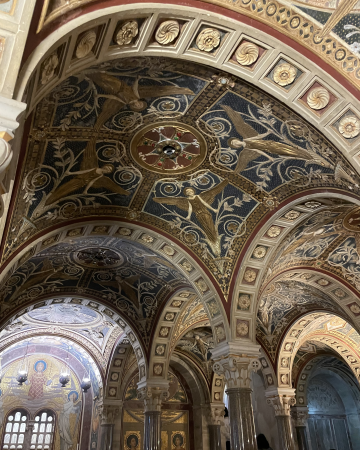
A friend recommended that we visit the Basilica of Santa Cecilia in Trastevere because of its mosaics, but even more exciting to me was learning that her home - yes, her actual home - was excavated underneath! Because she was a Christian during the time of persecution, the Church met secretly in St. Cecilia’s home for many years until her martyrdom in 230 AD. A larger church was later built on top of this site, where you can still venerate her relics today.
Although the top level of the church is impressive, what I loved most was the smaller chapel decorated entirely in mosaics which now fills a section of her home, and where you can get incredibly close to the site of her tomb. Several other ancient rooms of her home have remained with fragments of mosaic flooring.
(Read more about St. Cecilia’s life here.)
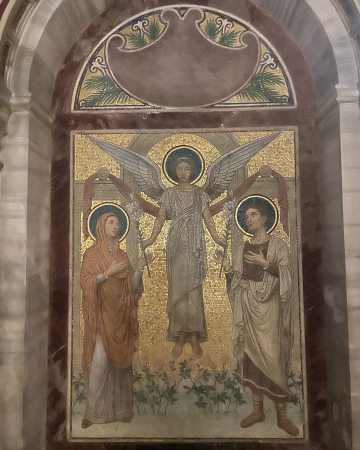
St. Catherine of Alexandria and Holy Theodora, wife of Sisinnius at the Basilica of San Clemente
The Basilica of San Clemente is another church in Rome which contains several layers of history. The first level, filled with some beautiful mosaics, also houses a chapel dedicated to St. Catherine of Alexandria, with beautiful frescos depicting the life of the saint.
As you descend to the second level, you enter a 4th century church containing medieval frescoes, dating from the 8th to the 11th century. One of these frescoes depicts an explosive moment in the lives of those who gathered in this church during the time of persecution.
Like St. Cecilia’s, this church was also the home of a wealthy couple named Theodora and Sisinnius. The difference here was that Theodora, who was a Christian, was hosting the church in their home without the knowledge of her husband Sisinnius, who was not.
One day, Sisinnius followed Theodora and discovered their meeting. Immediately, he was struck blind and deaf. Later that day St. Clement visited Theodora and restored her husband's sight and hearing. Sisinnius, however, was enraged to find the Bishop in his house and ordered his servants to arrest him. In what we can only assume is Holy-Spirit inspired confusion, they laid hold of some stone columns that were lying outside and proceeded to arrest these, urged on in colourful language by Sisinnius (signs at the site of this fresco tell us that apart from signatures in some documents, his words are the earliest known witness in writing to the transition from Latin to the vernacular Italian). Meanwhile St Clement slipped away, saying: Because of the hardness of your hearts you have merited to pull building materials away instead of me.
This is the end of the story when viewing the fresco, which stood in the church for many years. However, we know from other sources that Sisinnius was later converted and martyred for his faith. While we do not know what happened to Theodora, her courage will be remembered forever by refusing to live in fear of her husband’s violence.
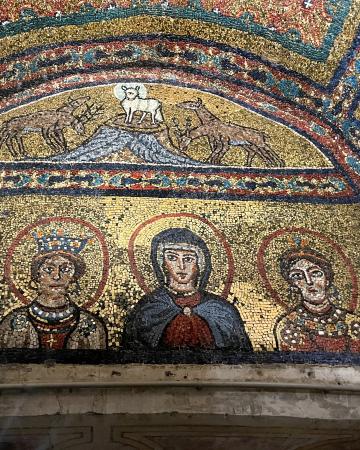
Sts. Agnes, Pudentiana, and Praxedes in the Chapel of St. Zeno
Built by Pope Paschal I as a mausoleum for his mother, Theodora, St. Zeno’s Chapel within the church of Basilica of Santa Prassede came to be known as the Orto del Paradiso, or Garden of Paradise. Like a tiny jewelbox glittering with light, it is filled floor-to-ceiling with 9th century mosaics. Along with the apostles, a few angels, and allegorical biblical scenes, the chapel prominently honors three female saints: St. Agnes and two sister saints, Sts. Praxedes and Pudentiana.
St. Agnes of Rome, a martyr from the 3rd century, was well-known throughout Rome for the miracles worked at her tomb. Her relics can still be venerated in two places: her skull at the church of Sant'Agnese in Agone in Rome's Piazza Navona, and the remainder of her bones at the church of Sant'Agnese Fuori le Mura, or St. Agnes Outside the Walls. Born in Rome during a time of persecution, she dedicated her life to God at an early age and was later martyred after refusing to marry a pagan suitor.
Sisters Praxedes and Pudentiana were also martyrs in Rome, although the date of their martyrdom is unknown. Together, they were said to have provided comfort and care to Christians persecuted in the Roman Empire, and were caught because of their efforts to give martyrs a Christian burial. The larger church that houses the Chapel of St. Zeno is dedicated to St. Praxedes, or Prassede, built on top of their family’s property, and includes images of the two sisters gathering the blood of the martyrs before courageously burying them.
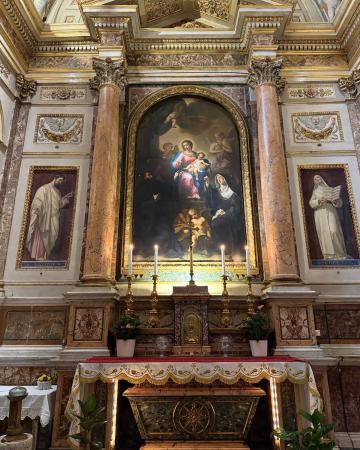
St. Monica of Hippo at the Church of Sant’ Agostino
The relics of St. Monica can be found in a side chapel of, fittingly, the church dedicated to her son, St. Augustine of Hippo. We visited during a time when renovations kept pilgrims from getting very close to her tomb, but were still glad we got the opportunity to venerate a woman whose prayers and devoted love for her children influenced the course of Christian history.
St. Monica was born in what is now Algeria around the year 322. She was married young to a Roman official named Patricius, who was violent and dissolute. He is said, however, to have held his wife in respect, however annoyed he would become at her almsgiving and prayer life. Their daughter Perpetua became an abbess, but St. Monica wept for her son Augustine's dissolute ways for many years. She finally followed him to Italy, where she became a disciple of St. Ambrose of Milan and finally succeeded in converting Augustine to Christianity. He subsequently became one of the most influential saints in the Western church. His Confessions were inspired by his grief at her death in 387.
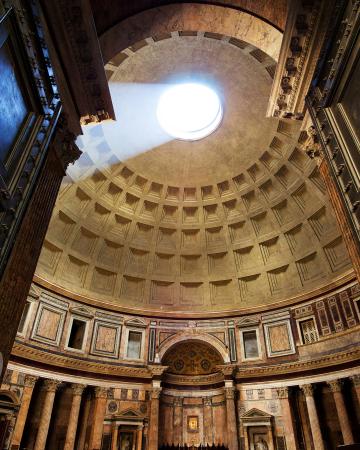
The Unnamed Martyrs of Rome
On our last day in Rome, we attended a liturgy at the Pantheon, which was a pagan temple before it became a Christian church dedicated to both the Theotokos and the Martyrs.
When dedicating the church in 609, Pope Boniface IV brought twenty-eight carriages carrying the bones of martyrs in a solemn procession from various Roman cemeteries and catacombs. As far as I could tell, their names have not been preserved. Standing there, joining in with the prayers of Christians since the early centuries, I couldn’t help thinking of all the female martyrs whose identities are known only to God: those who chose the courageous way of the Cross, and through it found the source of Life.
Although we do not know their names, may they pray for us as well, that we may whole-heartedly pursue the heart of Christ!
There are many other relics and churches we did not have time to visit while in Rome - if you have other saints or sites to recommend, we’d love to hear about them!