Life and Prayers of St. Demiana
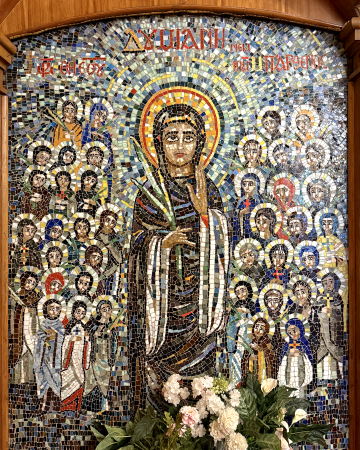
St. Demiana is known as a founder of female monasticism akin to St. Anthony the Great. She is called the Princess of Matryrs because she endured 2-3 years of torture.
Toward the end of the third century, there lived a Christian widower named Marcos. His only daughter, Demiana, was known for her beauty and goodness of heart. Marcos wanted to arrange a marriage between Demiana and a highly respected colleague, but she asked for a different kind of dowry - a house outside the city, where she could live removed from the world and spend her time in prayer. For a woman in this period, this was a bold request - daring to imagine a life without the social security and financial provision of marriage; daring to imagine a new possibility of self and of community. For the first time, Demiana defied the expectations of others - a blend of courage and imagination that would follow her throughout her life.
Yielding to her deep desire for a righteous life, her father granted Demiana her wish; but instead of a small house, he built her a large palace. Demiana eventually lived there with forty other women, forming their own religious community as they walked together. We know very little about this period of St. Demiana’s life, but we can imagine the joys and struggles of such a life together - learning to journey with other women through all the ups and downs of community life, struggling on together towards holiness with very little encouragement or support. We can imagine that Demiana was often called upon to heal small rifts or irritations, to encourage them on towards love and faithfulness, and to lead their works of prayer and mercy to the poor. For their community, this was the long, faithful journey of the heart.
Years later, Emperor Diocletian began to torture and kill Christians who refused to worship his idols. Soon, Demiana heard the terrible news that her father had caved to the Emperor’s pressure and bowed rather than face death. For possibly the first time, she left her community and went to him, bringing him back to his senses in love.
The Lady Demiana returned home and asked the Lord Jesus, “O Lord, my Lord, my God, Who do not desire the death of the sinner, but the life of everyone is existent by You; do not hold him accountable or blame him, my Lord and Master, for the rebellion and disobedience which he dared to commit against You, and for his worship of that which is made by hands. For You, O my Master, know of the deficiency, weakness, and inadequacy of human nature; You know that no person is devoid of error; and that our adversary stands vigilantly like a lion seeking whom he may devour. As you delivered Jonah the Prophet, the son of Amittai, and brought him out safely from the belly of the whale, O Lord, accept my father who had been swallowed by Satan. I ask You, O God, make him steadfast until he sheds his blood in Your Holy Name. For Yours is the glory and the honor, now and at all times, and unto the age of ages.”
In time, her father went back to Diocletian and declared himself a Christian. When the Emperor learned that it was Marcos’ daughter Demiana who had changed his mind, he ordered one hundred soldiers to attack the palace. “First, try to convince her to worship our idols”, he is reported to have said. “But, if she refuses, threaten her, torture her, and even kill her so that she will be an example for the other Christians.”
The soldiers came; Demiana and her sisters refused to relent, and were cruelly tortured for 2-3 years. Each day, the Archangel Michael is said to have appeared to Demiana, touching her with his heavenly wings and healing her wounds.
[In the midst of her tortures] She lifted her eyes up toward heaven and cried out saying, “O Only-Begotten Son, the Eternal Jesus Christ, Whom the Jews lifted up upon the Holy Cross and nailed between two thieves, through Your own will, lift up my mind, O my God, away from bodily concerns which disturb the mind, unto the remembrance of Your heavenly economy. Accept from me this little suffering; which is in the foremost for Your Holy Name, for Yours is glory, exaltation, and reverence, now, at all times, and unto the age of ages. Amen.”
On the last day before her martyrdom, Christ Himself appeared to her, saying, “Have courage, my chosen one.” The next day, she and her forty companions were beheaded: joined together in death as they had been in life. And they were not alone. Because many people believed in Christ through her testimony, the total number martyred with St. Demiana was about four hundred.
When the Virgin Lady Demiana saw the Virgins standing around her weeping she said to them, “Do not cry over me my sisters, for our Lord Christ – glory be to Him – endured pain on our behalf for our salvation, and He died in the flesh for us while there was no sin in Him deserving of death. His passion in the flesh was to save Adam and all his offspring from Hades. If God, the Pantocrator, accepted death and crucifixion by His own will, whist being sinless, how much more should I, His servant, act in obedience to Him? I ask for death and accept it in sweetness; for the blessed Apostle Paul said in his epistle, “For I consider that the sufferings of this present time are not worthy to be compared with the glory which shall be revealed in us.”
Demiana’s life is one of faithfulness - to her vocation, to her community, and ultimately to her faith and to Christ. Her icons show her surrounded by the support and testimony of her forty companions, as they bore witness and drew strength from each other even under the most severe circumstances. A glorification hymn states,“Rejoice O true bride, who has become an altar for the Holy Spirit, since her childhood.” It is this self-offering of her life, given with full consent and dignity, which became her most courageous and powerful legacy of love.
Holy Mother Demiana, pray to God for us!
Excerpts taken from THE LIFE OF THE VIRGIN SAINT DEMIANA and the Early HISTORY OF HER MONASTERY, Prepared by The Nuns of the Monastery of St. Demiana