Corinna Robinson on the Annunciation
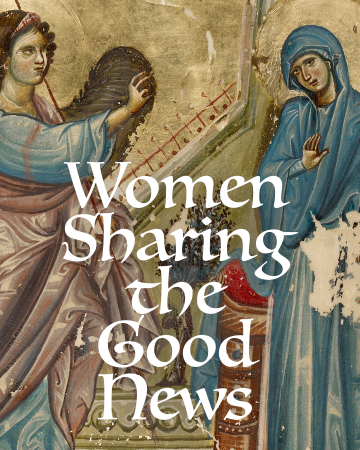
We had a wonderful eight weeks with Orthodox women across jurisdictions as part of our Women Sharing the Good News course which concluded recently. The theme for this course was "Saying Yes to God: Courage and Choice in the Lives of the Theotokos and St. Mary of Egypt." Over the next couple of weeks, we’ll be sharing a selection of participants’ final pieces with you. Our final piece is by Corinna Robinson:
How would you describe how you see God? At the beginning of a course I took on the Annunciation, we were each asked to describe our own icon in which Mary meets the angel Gabriel. Although we studied the same story, our visions differed widely. Some stayed close to traditional iconography, while others took more liberties. Some emphasized gesture and bodily expression that revealed hesitation or confidence; others explored divine and human creativity, picturing Mary in nature, among animals, or holding knitting or spinning handicrafts. This diversity revealed the variety of human perception and spiritual emphasis. Yet every image pointed toward the same divine narrative, and sharing our individual perspectives deepened our collective understanding. We saw differently, but spoke of the same God, demonstrating revelation can unfold through human difference.
This dynamic mirrors the Annunciation narrative in the Gospel of Luke, in which the angel Gabriel announces miraculous births to Mary as well as to the priest Zachariah and his wife Elizabeth. They hear similar messages, ask similar questions, and ultimately praise God in similar ways, but they arrive there through differing paths, signs, realizations, and ways of understanding. Just as our imagined icons reflected unique takes on one narrative, these individuals differ even as they bear witness to the same truth. The Annunciation suggests divine presence is encountered through the very particularities and perceptions that make us human.
Human senses are central to the narrative because, at its simplest, the Annunciation is a story of messages spoken and heard. Playing with this idea, in his homily on the Nativity St. Ephraim referred to the divine Word entering the Theotokos’s womb through her ear. Throughout the Gospel text, Gabriel, Mary, and Elizabeth also repeat the Greek word ἰδοὺ, which can be translated as “behold,” “look,” “see,” “recognize,” or “observe.” The word’s repetition invites us to snap out of our dazed monotony and pay attention as God’s actions unfold in real time. The signs of God’s presence are there for us to see, if we only look.
But how can we apply this invitation to perceive God to our own lives? The Theotokos was able to literally see, hear, and touch God in the Incarnation, but most of us are not. Yet the narrative also shows that if revelation is received through human perception, it is also understood and shared through human difference.
Zachariah, Mary, and Elizabeth each demonstrate a different mode of perceiving God. Gabriel appears to Zachariah first, telling him that his prayer has been heard and that his wife, Elizabeth, will bear a son, whom they should call John. Zachariah questions how this is possible, since he and his wife are beyond childbearing age, and for his lack of belief he is struck mute until the child’s birth.
What do we learn from this? We can see Zachariah as an example of someone who believes through sight and experience. Zachariah’s muteness causes him to believe in the angel’s message. His speech returns after he affirms his son should be named John, causing people throughout the region to discuss the miracles. While this sign-dependent recognition isn’t valorized by the text, we see in Zachariah that you can always come to believe, and sometimes this redemption allows even more people to hear of God’s goodness.
Mary, meanwhile, is characterized as relying on internal processing. When Gabriel tells her she will conceive a son, she considers his words and asks how this is possible. Our tradition often understands Mary’s questioning as a search for intellectual understanding; early Syriac authors describe Mary asking additional questions that exhibit reason and knowledge of the biblical tradition. For example, in one dialogue poem she asks why she should trust the angel’s message given Eve was deceived by another messenger. Later, she asks how she could conceive as it is against the laws of nature for a virgin to do so.
In the Gospel narrative, after receiving coherent responses from Gabriel, Mary assents and believes in his message. She later proclaims this belief in interpretative praise, comparing her individual blessing to God’s acts on behalf of the oppressed throughout history. In the Theotokos, we see someone who knows God’s presence through discernment and pattern recognition. From her, we learn the importance of maintaining balance between our human intellect and openness to divine mystery.
Elizabeth exhibits yet another manner of perceiving God’s presence. In the biblical text, we’re told simply that Elizabeth recognizes her pregnancy as confirmation God has paid attention to her. Later, Elizabeth knows through the Holy Spirit that Mary is carrying Christ. She speaks out “with a great cry,” sharing that as soon as she heard Mary’s voice, the child in her womb leapt for joy. Here, we see an embodied and intuitive recognition of God’s presence, with Elizabeth sensing this presence in Mary’s womb through her bodily responses of hearing and a literal “gut feeling.”
Through these three figures, the Annunciation narrative shows that each one of us perceives God in a different manner, with different emphases, but we all bear witness to the same divine reality. Our unique experiences, personalities, and gifts act as the individual colors in a tapestry; they are distinct, yet create one cohesive image when woven together.
Maybe you perceive God in a manner similar to one of these individuals, or maybe God shows Himself to you in another way—through your compassion for those around you, through theological study, through the wonder of nature, through the words of a poem or song.
I invite each of us to spend time reflecting on how God has uniquely created us to feel His presence. Recognizing this presence requires attentiveness as we journey through life, learning how to behold God as He appears to us. When we do this, we discover what has always been true: Christ is in our midst, and God is with us, everywhere present and filling all things—if only we learn to look.