The Daughter of Nero
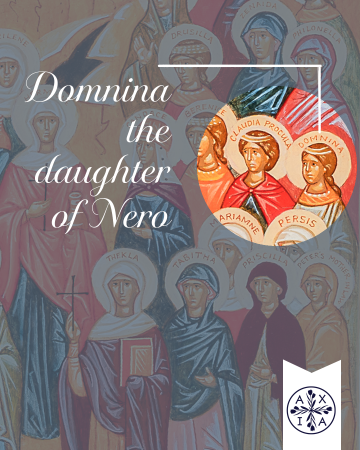
Can you imagine converting to a religion whose followers were dying gruesome and terrible deaths because of their belief? Even more, can you imagine that it was your own father commanding these terrible punishments?
This was the situation of Domnina, the daughter of Nero. The little we know about her life is this: she was the daughter of a powerful emperor, had at least 100 servants attending her day and night, and that she was not about to let wealth and privilege blind her to the truth.
The story opens with the coming of St. Photini—the Samaritan woman—and her family to Carthage. One of St. Photini’s sons ended up converting his military commander to Christianity. This enraged the Emperor Nero, who was just beginning his famous persecutions of Christians, including the martyrdom of Sts. Peter and Paul.
Nero summoned St. Photini and her family to Rome and interrogated them about their faith. Then he ordered that they be beaten with iron rods until they denied Christ. However, no matter how hard the soldiers tried, they could not break their bones.
Enter Domnina. When we think of her story, we imagine her in her life of palace luxury, but she must have been asking questions of her own. Could she have heard reports of all going on in the kingdom? Was she trying to form her own opinions of the persecutions sweeping her city? She may have felt the emptiness of the life she was living, and a hunger was growing within her, a hunger she could not name.
Whatever her story, her father Nero asked Domina to meet St. Photini in a room full of gold and riches. His plan was for Domnina to use all her persuasive powers to tempt St. Photini with the luxury she herself enjoyed, and bring her to deny the faith. Instead, Domnina and St. Photini seemed to have had a long heart-to-heart chat about riches in Christ, a conversation that became the turning point of Domnina’s life. In the faith of this passionate, intelligent, courageous woman, she had found the Life she was searching for.
Domnina would go on to convert to Christianity and bring her one hundred servants along with her. After a brief catechism, St. Photini baptized them all. Some sources say she gave Domnina the name Anthousa, which means “flower.” After her baptism, Domnina immediately ordered all the gold and jewels which were used to tempt St. Photini to be distributed to the poor of Rome.
St. Photini and her family, after this spectacular failure on Nero’s part, would spend three years in prison and experience torture of many kinds. Even then, they turned their prison into a place of holiness, healing many and filling it with the fragrance of myrrh. Eventually, they would all receive the crown of martyrdom.
It is not clear what happened to Domnina after St. Photini’s imprisonment and death, but it’s likely that she faced a very different life than the one of luxury and privilege she had known. Did she have the opportunity to visit St. Photini and her family in prison, and continue being catechized in the faith? Was she able to participate in any kind of Christian community, or did she and her servants form a community of their own?
Either way, it’s safe to say that she needed all the courage, wisdom, graciousness, and perseverance she possessed to continue steadfast in the faith of Christ until the day of her death, awaiting the day when her long search for Life would be totally fulfilled.
There are so many incredible women like Domnina who labored side-by-side to nourish and support the early Church. In Heather MacKean’s icon of the Women of the New Testament, Domnina is on the middle right-hand side of the icon. A high-quality 8×10 print of this icon, produced on heavyweight, acid-free cardstock with a matte finish, is our thank you gift to everyone who donates $100 or more—or a monthly commitment of $10 or more–to our Myrrhbearing Women Fundraiser.
If you are already a monthly donor, thank you! Any amount you are able to increase your donation will come with a thank-you gift of an icon to your mailbox! Your support directly makes possible gatherings, scholarships, and resources that enable Orthodox women to come together across differences, deepen in faith, and find the encouragement and training they need to live out their callings in the Church.